The Best Marketing Methods for Small Business in 2026 That Run on Autopilot — No Team, No Agency, No Guesswork
Most small businesses use the right marketing methods the wrong way — manually and without a system. This guide covers the 12 best marketing methods for small business in 2026 and how to automate every single one.

Most entrepreneurs I have spoken to already know what works. The best marketing methods for small business have not changed dramatically — email marketing, SEO, social media, referrals, paid ads. The information is everywhere. Free. Accessible. Endlessly discussed.
And yet the majority of small businesses are still not getting the results these methods promise. Not because the methods are wrong. Because they are being executed manually, inconsistently, and in complete isolation from each other — and a disconnected collection of tactics is not a marketing system. It is a to-do list. One that requires you to show up every single day to keep it alive.
Here is the number that puts this into sharp focus. Marketing automation saves companies six or more hours per week on routine tasks like social media posting and email marketing. Firework That is three full working days handed back every single month — simply by letting the right tools do what most small business owners are still doing by hand. And that is before we even talk about what automation does to revenue.
I have spent years helping solopreneurs and small business owners build marketing systems that run without them. What I keep finding is that the gap between a business growing steadily and one grinding through flat months is almost never the quality of the methods being used. It is whether those methods are connected, automated, and compounding — or whether they depend entirely on the owner's energy to keep moving.
That dependency is the trap. And this post is how you get out of it.
What follows is a complete, field-tested autopilot marketing playbook — 12 methods organised from foundation to advanced strategy, each with the exact automation layer that makes it run without you. I will also walk you through the lean tech stack that powers all 12 for under $150 a month and the no-code priority roadmap that tells you exactly what to build first.
No team. No agency. No guesswork. Just a system built once, running forever, compounding while you focus on everything else that actually needs you.
The entrepreneurs already doing this are not smarter or better resourced. They just made one decision earlier than everyone else. This post is that decision.
1) Why Most Small Businesses Get Their Marketing Methods Completely Wrong

There is a pattern I keep seeing across small businesses at every stage — startups, established solopreneurs, even businesses turning solid revenue. They are not failing because they chose the wrong marketing methods. They are failing because they are running the right methods in a structure that was never designed to scale.
Let me give you a concrete example. A few months ago I sat down with the owner of a small bookkeeping firm — sharp, organised, genuinely great at his work. He had an email list, a Google Business Profile with 40+ reviews, a LinkedIn presence he maintained three times a week, and a referral programme he mentioned to clients at the end of each engagement. On paper, an impressive marketing operation for a one-person business.
His revenue had not grown in nine months.
When I walked through each channel with him, the problem became obvious immediately. His email list had no welcome sequence — new subscribers received nothing until his next manual newsletter. His Google Business Profile had no automated review request attached to it. His LinkedIn posts were not driving traffic anywhere with a lead capture mechanism. And his referral programme existed only as a verbal mention — no trigger, no follow-up, no system. Every channel was working in complete isolation. Nothing compounded. Nothing connected.
He was not doing bad marketing. He was doing disconnected marketing. And disconnected marketing — no matter how consistently executed — has a hard ceiling. That ceiling is you.
The Manual Marketing Trap — And Why It Keeps You Stuck
The manual marketing trap is not a motivation problem. Every small business owner I have ever worked with puts in more effort than people twice their size with bigger budgets. The problem is structural.
When every marketing action requires your direct involvement — every email sent, every review requested, every follow-up made — your marketing output is permanently capped by your available hours. You are not building a system. You are building a dependency. And dependencies do not scale.
66.3% of small business owners spend less than $1,000 on marketing each year Revenue Memo — and a significant portion of that constraint is not about budget at all. It is about bandwidth. When marketing is manual, it competes directly with every other demand on your time. Something always loses. Usually it is the marketing.
The compounding effect of this is brutal. Inconsistent email sends mean inconsistent revenue. Irregular social posting means inconsistent visibility. Referral requests that only go out when you remember them mean a referral pipeline that runs on luck rather than system. The best marketing methods for small business deliver compounding results — but only when they are running consistently. Manual execution makes consistency structurally impossible for anyone running a business alone.
What a Real Autopilot Marketing System Looks Like
I want to be precise about what I mean by autopilot — because the word gets used loosely and it matters to define it correctly here.
An autopilot marketing system is not a single platform. It is not a complicated technical setup. It is a connected sequence of proven marketing methods where every handoff between steps happens automatically, without you initiating it. A visitor finds your content through SEO. They land on a page with a lead magnet. They opt in. A welcome sequence fires instantly — no manual send required. Seven days later a referral request goes out automatically. Forty-eight hours after their first purchase a review request follows. If they clicked your ad but did not convert, retargeting picks them back up within hours.
Every step in that chain is a method you already know works. The difference between a business that grows and one that plateaus is not which methods are being used — it is whether those methods are running on a system or running on the owner's energy.
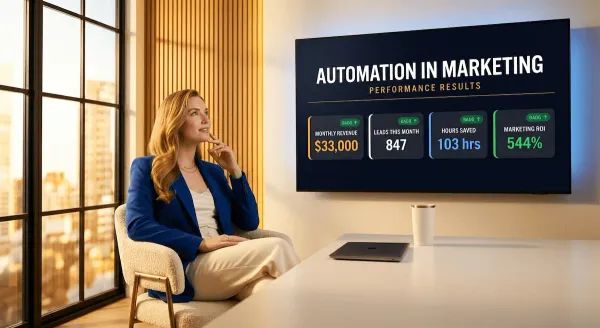
Companies see $5.44 in revenue for every $1 spent on marketing automation Thunderbit — a return that only becomes possible when individual marketing methods stop being standalone tasks and start functioning as a connected, self-running system. That is what automation in marketing actually delivers at the small business level — not complexity, just connection.
And here is what I find most encouraging about this for solopreneurs specifically: building this system does not require a tech background, a marketing team, or an agency. It requires the right sequence, the right tools, and a clear understanding of what to build first. I cover all three across the sections ahead.
What I want you to take from this section is one core shift in thinking. Stop asking: "Which marketing method should I try next?" Start asking: "How do I make the methods I already know work run without me?" That question is what separates automated marketing for small business from the exhausting manual approach most entrepreneurs are still stuck in.
🎯 Pro Tip
Don't audit your marketing channels. Audit the handoffs between them.
Most small businesses have the right methods in place — email, SEO, referrals, reviews — but each one runs as a standalone task. The real diagnostic question isn't "Am I doing email marketing?" It's "What happens automatically the moment someone joins my list, makes a purchase, or refers a friend?" If the answer is nothing — that's where your revenue is leaking. Fix the handoffs before you add any new channels.
The answer starts with the four foundation methods every small business must have running before anything else is worth building on top of.
2) The Foundation Layer: Methods 1–4 That Every Small Business Must Have Running First
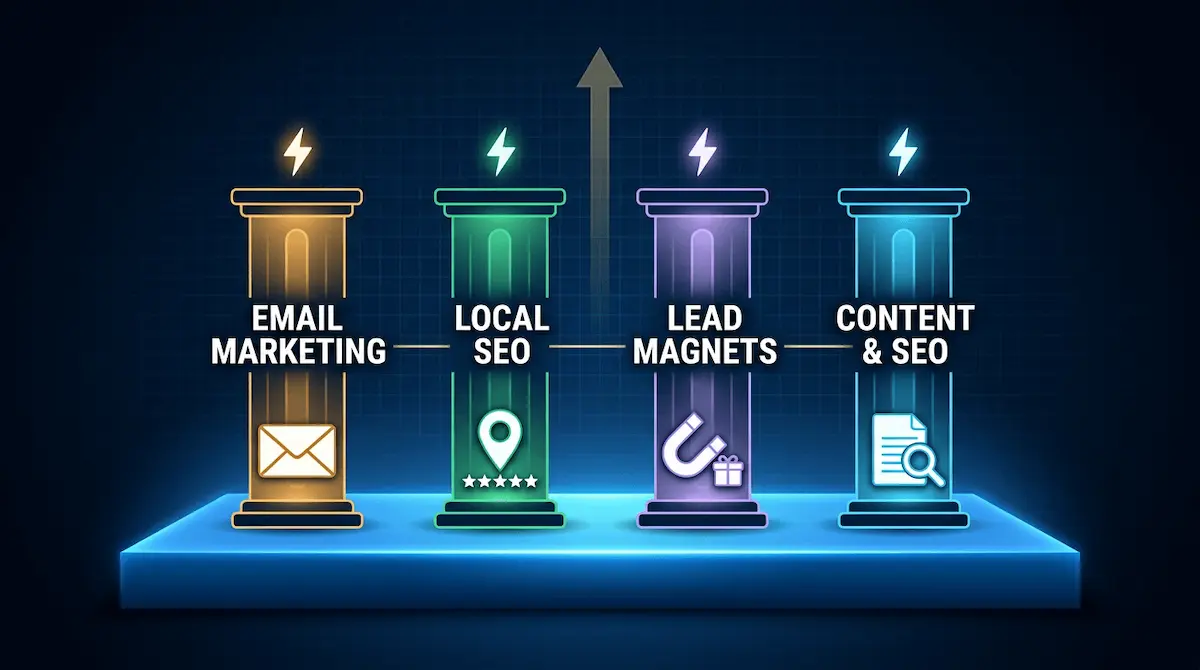
Before anyone talks about growth tactics, advanced strategies, or the latest AI-powered tools, there are four marketing methods that have to be in place and running on autopilot. I call these the foundation layer — not because they are basic, but because everything else you build depends on them working properly underneath.
When these four are connected and automated, your marketing compounds. When they are missing or manual, everything above them is built on sand. I have watched businesses invest heavily in paid ads, influencer partnerships, and content strategies — only to see the results evaporate because there was no reliable email list capturing the leads, no Google presence converting the traffic, and no lead magnet turning curious visitors into actual subscribers.
Start here. Every time.
Method 1 — Email Marketing: The Highest-ROI Channel You Cannot Afford to Under-Invest In
Email is not glamorous. It does not get the attention that social media does, and it rarely comes up in conversations about cutting-edge marketing. But the numbers are about as clear as any data point in marketing: for every $1 spent on email, businesses see an average return of $36 — a 3,600% ROI that no other channel comes close to matching consistently (Litmus).
What makes email the most valuable foundation method for small businesses specifically is that it is the one channel you own outright. Your Instagram following can disappear with an algorithm change. Your organic search traffic can drop overnight after a Google update. Your email list belongs to you — and 53% of small business owners in the US, UK, Canada, and Australia already use email marketing as their most frequent strategy for both finding new customers and retaining existing ones Constant Contact (Constant Contact, 2024).
The mistake I see most often is treating email as a broadcast channel — a place to send a newsletter when you have something to say. That model is leaving serious money on the table. The real value of email as a foundation method comes when it is automated: a welcome sequence that fires the moment someone subscribes, a nurture sequence that builds trust over seven to ten days, a re-engagement sequence that activates dormant subscribers without you lifting a finger. Automated emails generate 320% more revenue than non-automated campaigns OptinMonster (OptinMonster). That gap is not marginal — it is structural. Manual email is a newsletter. Automated email is a sales system.
For email marketing for business at the solopreneur level, the platform matters less than the system. MailerLite, ConvertKit, and ActiveCampaign are all capable of running the sequences you need. What separates businesses that see results from those that do not is whether the automation is actually built and switched on.
Method 2 — Local SEO and Google Business Profile: The Free Traffic Channel Most Small Businesses Ignore
If your business serves customers in a specific city, region, or geographic area, local SEO is not optional. It is the single highest-converting free traffic source available to you — and most small businesses are either ignoring it entirely or treating it as a one-time setup task.
46% of all Google searches have local intent, and 76% of people who conduct a local search visit a business within 24 hours User's blog (Forbes / Google). These are not window shoppers. They are buyers actively looking for what you offer, right now, in your area.
Your Google Business Profile is the front door to all of that traffic. Customers are 70% more likely to visit and 50% more likely to consider purchasing from businesses with a complete Business Profile SOCi (Google). Yet in my experience reviewing small business profiles, the majority are incomplete — missing service descriptions, outdated photos, no systematic review strategy, and posting activity that stopped months ago.
The businesses winning in local search in 2026 are treating their Google Business Profile as an active marketing channel, not a static directory listing. That means weekly posts, consistent photo updates, and a review acquisition system that runs automatically — not a manual request you remember to make at the end of a good client call. Businesses listed in the Google 3-Pack receive 126% more traffic and 93% more actions — calls and website clicks — compared to those ranked 4 through 10 SeoProfy (SeoProfy). Getting into that top three is the goal. Staying there requires consistent activity.
Method 3 — Lead Magnets: Turning Traffic Into a List You Actually Own
Here is the gap I see in almost every small business marketing setup I review. They are generating traffic — from Google, from social media, from referrals — and sending it to a homepage with no mechanism to capture an email address. Every visitor who does not convert immediately is gone forever.
A well-designed lead magnet solves this problem permanently. It gives a visitor a specific, immediately useful reason to hand over their email address — and it converts cold traffic into a warm list that you can nurture on autopilot.
The data on what actually converts is worth paying attention to. According to a 2024 HubSpot report, the average conversion rate for gated eBooks has dropped below 0.9%, while interactive tools like quizzes and templates now convert upwards of 5.2% Salesfully — nearly a 6x difference. The era of the generic eBook is over. What converts in 2026 is specificity and speed: a checklist that solves one precise problem, a template that saves two hours of work, a calculator that gives an instant answer.
Adding a lead magnet to a popup opt-in form raises mobile conversion from roughly 3.8% to 7.7% and desktop conversion from 1.8% to 4.7% — a 100 to 155% lift Amra & Elma (Amra & Elma). The mechanic is straightforward: match the lead magnet to the search intent of the traffic source, make the value immediately obvious, deliver it instantly, and trigger a welcome sequence the moment they opt in.
Method 4 — Content and SEO: The Compounding Asset That Pays You While You Sleep
The reason content and SEO belong in the foundation layer — not the growth layer — is compounding. Every well-optimised piece of content you publish is a permanent asset that generates traffic, builds authority, and feeds your email list without any ongoing cost per click. Paid ads stop the moment you stop paying. Content does the opposite — it builds value over time.
For small businesses without a dedicated marketing team, the key to making content work is focus. One primary keyword per piece of content. One clear call to action per page. One lead magnet connected to each high-traffic post. That system — content bringing in traffic, traffic hitting a lead magnet, lead magnet triggering an email sequence — is the compounding engine that the best email marketing small business strategies are built on.
⚡ Automate It — Foundation Layer
One tool (or tool pair) to automate each of the four foundation methods:
| Method | Tool | What It Automates |
|---|---|---|
| Email Marketing | MailerLite / ConvertKit | Welcome sequence, nurture flow, re-engagement |
| Local SEO / GBP | NiceJob / Google Search Console | Review requests, GBP post scheduling, ranking alerts |
| Lead Magnet | ConvertKit / OptinMonster | Opt-in delivery, instant welcome email, list tagging |
| Content & SEO | Surfer SEO / Ubersuggest | Keyword targeting, content scoring, rank tracking |
💡 All four tools connect via Zapier or Make — so a new subscriber, review, or content publish can trigger automated actions across your entire foundation stack simultaneously.
These four foundation methods are not complicated. They are not new. What makes the difference at the small business level is whether they are running on a connected, automated system — or whether they are being executed manually, inconsistently, and in isolation from each other. The next section covers the four growth layer methods you build on top of this foundation once it is running.
3) The Growth Layer: The Best Marketing Methods for Small Business That Build Momentum
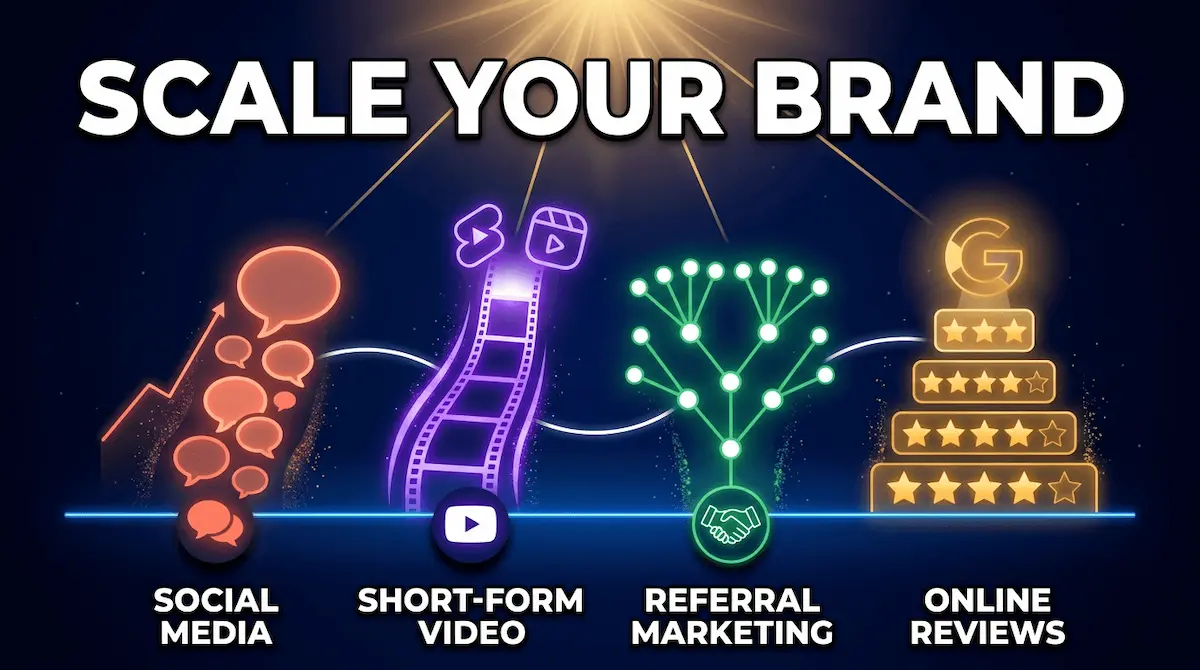
Once your foundation layer is running — email capturing leads, local SEO driving traffic, a lead magnet converting visitors, content compounding over time — you have something most small businesses never actually build: a base. A reliable, automated floor of marketing activity that works whether you are in the office or not.
The four methods in this section are what you build on top of that floor. I call them the growth layer because that is exactly what they do — they amplify what is already working, extend your reach into new channels, and create a self-reinforcing cycle of visibility, trust, and referrals that compounds month over month. None of them require a marketing team. All of them can be automated. And together, they transform a functional marketing foundation into a genuine growth engine.
Method 5 — Social Media: Show Up Consistently Without Living On It
Let me be direct about something that most marketing advice gets wrong when it comes to social media for small businesses. The goal is not to go viral. The goal is not to build a massive following. The goal is to show up consistently enough on the one or two platforms where your specific audience actually spends time, so that when someone is ready to buy what you offer, your name is already familiar to them.
That goal is entirely achievable without spending hours a day creating content. The businesses winning on social in 2026 are not the ones posting the most — they are the ones posting with the most relevance and the most consistency. Social-first brands with mature social strategies see an average year-over-year revenue growth of 10.2% Sprout Social (Deloitte Digital, 2024). That number does not come from going viral once. It comes from showing up reliably, month after month, with content that means something to the right audience.
For most small businesses, that means picking one primary platform based on where your customers actually are — Facebook for local service businesses, Instagram or TikTok for visual or consumer-facing brands, LinkedIn for B2B — and building a simple repeatable content system. Three to five posts per week. One content type that performs well for you. A scheduling tool that queues everything in advance. That is it. The channel compounds when the system is consistent. The system is only consistent when it is automated.
Method 6 — Short-Form Video: The Highest-Organic-Reach Format Available Right Now
I am going to be honest — when I first started advising small business owners to prioritise short-form video, the pushback was predictable. Too time-consuming. Too uncomfortable on camera. Not relevant to their industry. I have heard all of it. And I understand it. But the data has stopped being something you can argue with.
Short-form social videos drive the highest ROI among all video formats for B2B marketers at 41%, ahead of brand storytelling at 38% and testimonials at 34% Sprout Social (Sprout Social). And that is in B2B — where video was considered optional for years. For consumer-facing small businesses, the numbers are even more compelling. YouTube Shorts exceeded 70 billion daily views globally in 2024 Brand Vision, and Reels remain the single highest-reach organic format on Instagram by a significant margin.
What makes short-form video particularly powerful for solopreneurs is that it does not require production quality. It requires authenticity and relevance. A 60-second walkthrough of how you solved a client problem. A 45-second answer to the question your customers ask most often. A behind-the-scenes clip of your process. These are not complicated to produce — and when they are batched and scheduled in advance, they stop being a daily creative burden and become a repeatable part of your content system.
The one rule I give every small business owner I work with: film in batches, not in real time. Block two hours once a week. Film six to eight short clips. Schedule them across the week. Never scramble for content again.
Method 7 — Referral Marketing: The Channel With the Highest Conversion Rate You Are Probably Not Using Systematically
82% of small businesses claim referrals are their primary source of new customers Firework (Firework). That is a remarkable statistic — and it reveals one of the most frustrating gaps I see in small business marketing. The channel delivering most of their new customers is the one they have done the least to systematise.
Most small business referrals happen by accident. A happy client mentions you to a friend. A customer shares your name in a local Facebook group. Word gets around. These are great outcomes — but they are driven by luck and timing, not by a system. The moment you put a system behind referral marketing, the results are not incremental. They are transformational. Referral marketing generates 3 to 5 times higher conversion rates than any other channel, and referral programs lead to 69% faster deal closures Persuasion Nation (Persuasion Nation).
The system does not need to be complicated. An automated email that goes out seven days after a positive interaction, asking your happiest clients to refer someone they know. A simple incentive — a discount, a free resource, a small gift — attached to successful referrals. A follow-up sequence that nurtures the referred lead from introduction to conversion. That entire system can be built in an afternoon and run on autopilot from that point forward. The automated sales and marketing frameworks that deliver consistent referral results are not complex — they are just connected.
Method 8 — Online Reviews: The Trust Signal That Converts Strangers Into Buyers
Reviews are not a reputation management tool. They are a revenue driver. The distinction matters enormously for how you treat them strategically.
A one-star increase in ratings leads to a 5 to 9% rise in revenue Wiserreview, and businesses with more than 200 reviews earn 82% more in annual revenue compared to businesses with below-average review counts Marquiz. These are not marginal improvements. They are structural revenue differences driven entirely by social proof — and they are available to every small business willing to build a system around asking for reviews consistently.
The reason most small businesses underperform on reviews is not that their customers are unhappy. It is that they never ask. 32% of consumers say they would write more local business reviews — but businesses simply are not asking them GatherUp (GatherUp). An automated review request — sent via email 48 to 72 hours after a completed service or delivery — changes that equation permanently. When the ask is consistent, the reviews accumulate. When the reviews accumulate, trust builds. When trust builds, conversion rates improve across every other channel you are running.
Reviews also feed directly back into your marketing solutions for small businesses stack — boosting your Google Business Profile ranking, improving ad conversion rates, and giving you a steady stream of social proof content to repurpose across all your channels.
⚡ Automate It — Growth Layer
One tool (or tool pair) to automate each of the four growth methods:
| Method | Tool | What It Automates |
|---|---|---|
| Social Media | Buffer / SocialBee | Post scheduling, queue management, repurposing across platforms |
| Short-Form Video | Metricool / Repurpose.io | Cross-posting Reels/Shorts/TikToks from one upload |
| Referral Marketing | ReferralHero / ConvertKit | Referral request emails, incentive delivery, lead nurture sequence |
| Online Reviews | NiceJob / Birdeye | Review request timing, multi-platform routing, response alerts |
💡 Connect your growth layer tools to your email platform via Zapier — so a new 5-star review can automatically trigger a social post, and a completed referral can trigger a thank-you sequence without any manual input.
With your foundation and growth layers running, you have eight automated marketing methods compounding simultaneously. The next section covers the four advanced methods that most small business owners never reach — not because they are complicated, but because they never built the base that makes them worth deploying.
4) The Advanced Layer: Methods 9–12 Most Small Business Owners Never Reach
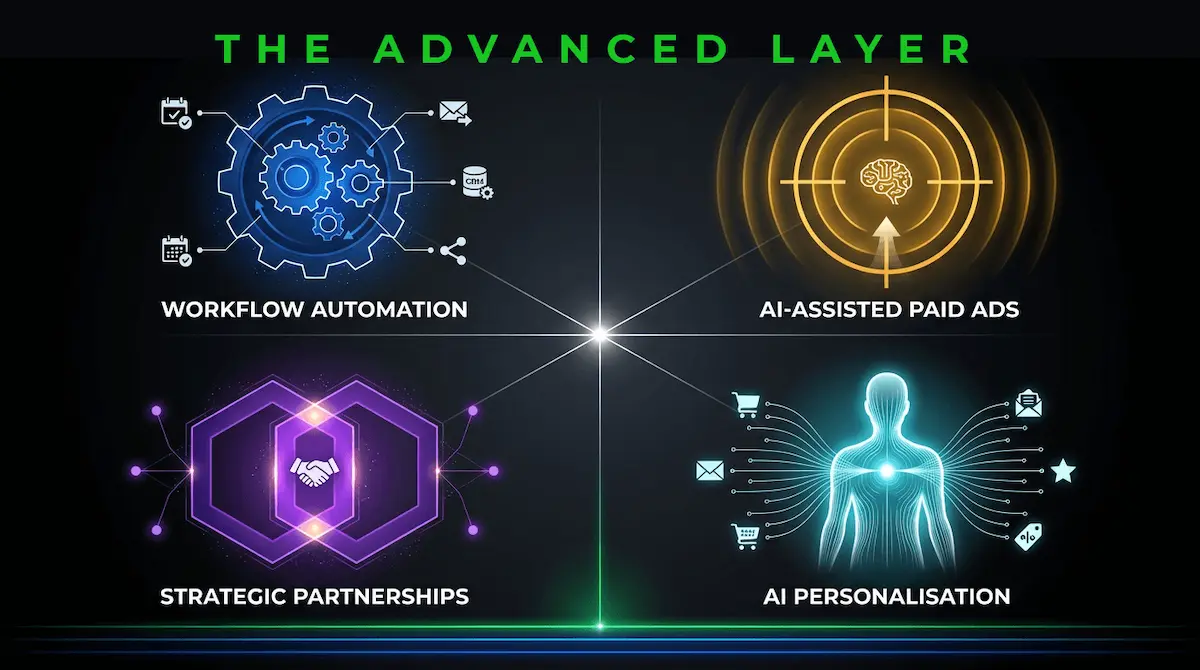
Here is a truth I have come to accept after years of working with solopreneurs and small business owners on their marketing: most never reach the advanced layer. Not because it is too complex. Not because they lack the budget. But because they never built a stable enough foundation underneath it to make the advanced methods worth deploying.
That is the real barrier — not knowledge, not tools, not time. It is sequence. You cannot run predictive AI personalisation when you have no email list to personalise to. You cannot run profitable paid ads when you have no conversion-optimised funnel to send the traffic through. The advanced layer works because the eight methods beneath it have already done the heavy lifting. Deployed on top of a running system, these four methods are where growth stops being linear and starts compounding exponentially.
If you have been building the foundation and growth layers as you read, this section is where things get genuinely exciting.
Method 9 — Workflow Automation: The Operating System Behind Every Efficient Marketing Stack
I want to reframe how most small business owners think about automation workflows, because the framing matters enormously.
Automation workflows are not a feature of your email platform. They are not a setting inside your CRM. They are the connective tissue between every tool in your stack — the logic layer that decides what happens automatically when a customer takes an action, misses a touchpoint, or reaches a milestone. When this layer is built properly, your entire marketing operation runs like a single coordinated system rather than a collection of individual tools.
Small businesses that implement marketing automation see a 25% increase in marketing ROI Cazoomi, and companies using automation generate 80% more leads and achieve 77% higher conversions Cropink (VentureBeat/Nucleus Research). Those numbers reflect what happens when individual marketing actions stop being standalone tasks and start triggering each other automatically.
The workflows that deliver the biggest impact at the solopreneur level are not complicated. A new subscriber triggers a five-email welcome and nurture sequence. A completed purchase triggers a review request at 48 hours and a referral request at seven days. A lead who opens three emails but does not convert triggers a re-engagement sequence with a time-sensitive offer. A new five-star review automatically gets repurposed as a social proof post. These are not advanced technical builds. They are simple if-then logic sequences — and once they are running, they create a marketing operation that responds to customer behaviour automatically, around the clock, without you.
The deeper value of automation and AI in this layer is not efficiency. It is consistency. Manual marketing is only as consistent as your energy levels allow. Automated workflows are perfectly consistent every single time — which means every customer gets the same quality experience whether you sent the sequence or not.
Method 10 — AI-Assisted Paid Ads: Making Paid Traffic Profitable Without a Media Buyer
Paid advertising has historically been the method most small business owners waste money on before abandoning. The reason is almost never the platform — it is the absence of a conversion-ready funnel to send paid traffic into. Traffic without a system is just an expense. Traffic flowing into a connected foundation — lead magnet capturing emails, welcome sequence nurturing leads, review social proof building trust — is where paid ads become profitable.
Companies leveraging AI for customer targeting report 40% higher conversion rates and 35% increases in average order values Cubeo. What has changed dramatically in the last two years is that the AI layer inside platforms like Meta Advantage+ and Google Performance Max now does the targeting work that previously required a specialist. The platform identifies your highest-converting audience segments, tests creative variations automatically, and shifts budget toward what is performing in real time — without manual intervention.
For a small business owner running a lean stack, this is significant. You do not need a media buyer. You do not need to master campaign architecture. You need a proven offer, a conversion-optimised landing page, and enough data from your organic channels to seed the algorithm with a clear signal of who your best customers are. The foundation layer builds that data. The paid layer amplifies it.
The key constraint I give every small business owner before they touch paid ads: your funnel must convert cold organic traffic first. If your lead magnet is not capturing emails from free traffic, paying to send more traffic to it will not fix the problem. Sequence matters.
Method 11 — Strategic Partnerships: The Zero-Cost Growth Channel Nobody Talks About
Strategic partnerships are the most underrated method in this entire post. They cost nothing to execute. They access audiences that took other businesses years to build. And when they are set up well, they generate compounding referral volume without any ongoing effort on your part.
The model is straightforward. You identify five to ten non-competing businesses that serve the same customer you serve. A graphic designer partnering with a web developer. A bookkeeper partnering with a business coach. A personal trainer partnering with a nutritionist. You agree to refer each other's ideal clients — either informally through a cross-referral arrangement or formally through a commission structure.
Referred customers are 50% more likely to make a second purchase, and brands with formalised referral and partnership programmes see three times the conversion rate compared to other acquisition strategies Firework (Firework). The difference between a casual partnership and one that generates consistent volume is a system — an automated introduction email, a shared lead magnet, a co-branded offer that gives the referred lead an immediate reason to act.
This is a method I have seen transform small businesses in saturated local markets. The business that builds five strong strategic partnerships effectively multiplies its reach by the combined audience of its partners — at zero acquisition cost. It requires relationship-building and a clear value exchange, but no ad spend, no platform algorithm, and no ongoing content production.
Method 12 — AI Personalisation: The Method That Makes Everything Else More Effective
The final method in the advanced layer is the one that, when implemented correctly, raises the performance ceiling of every other method you are running simultaneously.
AI personalisation is the practice of using behavioural data — which pages a subscriber visited, which emails they opened, which products they viewed, how long they have been on your list — to serve dynamically tailored content and offers rather than sending the same message to everyone. 71% of consumers now expect personalised interactions from companies, and 76% report frustration when they do not receive them Marketing LTB (Twilio Segment). At the same time, brands mastering AI-powered personalisation can lift digital sales by 15% to 30% — often within the first quarter of implementation Marketing insider (Boston Consulting Group).
For a solopreneur, this does not require an enterprise tech stack. Modern email platforms like ActiveCampaign and Klaviyo have behavioural tagging built in — so you can segment subscribers automatically based on what they click, what they buy, and what they ignore. A subscriber who clicks your pricing page three times gets a different follow-up than one who only opens your newsletter. A customer who purchased six months ago and has not returned gets a win-back sequence. A lead who downloaded your most advanced resource gets fast-tracked to your highest-value offer.
The automation business process framework that makes personalisation work at the small business level is not about complexity — it is about paying attention to behaviour signals and automating the right response. When you do this across all twelve methods simultaneously, your marketing stops feeling like broadcasts and starts feeling like conversations. And conversations convert.
🎯 Pro Tip — Advanced Layer
Deploy the advanced layer in this exact sequence. Order matters.
| Step | Method | Why This Order |
|---|---|---|
| 1st | Workflow Automation | Build the connective tissue first — everything else runs through it |
| 2nd | Strategic Partnerships | Zero-cost audience expansion before you pay for traffic |
| 3rd | AI-Assisted Paid Ads | Amplify a funnel that already converts — never fund a broken one |
| 4th | AI Personalisation | Layer on top of proven workflows — raises performance of everything above it |
⚠️ Skipping to paid ads before your foundation is running is the single most common and most expensive mistake I see small business owners make.
With all twelve methods mapped and the advanced layer in place, the only remaining question is execution. The next section covers exactly how to build this system without a tech background, a developer, or an agency — using a lean no-code stack that runs everything automatically.
5) How to Run the Best Marketing Methods for Small Business Without a Tech Background
Every system I have described across the foundation, growth, and advanced layers can be built without writing a single line of code. I want to be direct about this because the tech barrier — real or perceived — is the reason most small business owners never actually build the system. They read the frameworks, understand the logic, and then stall at the point of execution because they assume automation requires a developer, a technical co-founder, or an agency on retainer.
It does not. No-code automation platforms can free up 15 to 25 hours weekly by handling repetitive tasks like email campaigns and social media posting Research.com — and every major platform in the stack I am about to describe has been built specifically for non-technical users to operate independently.
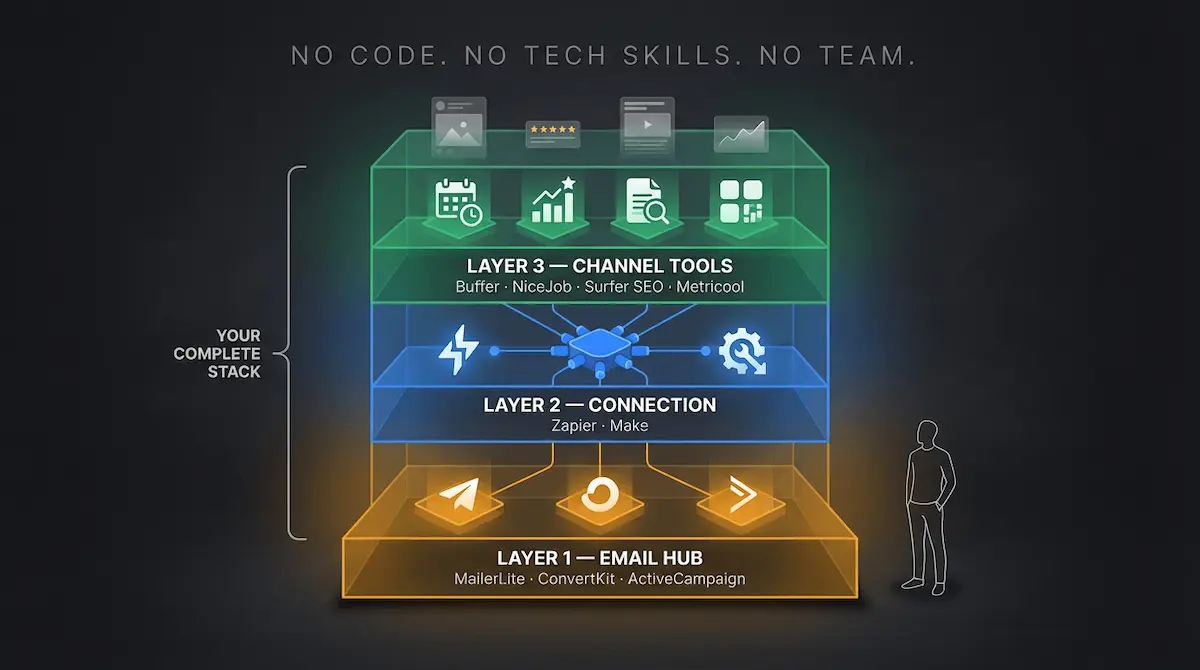
The Three-Layer No-Code Stack
The entire twelve-method system runs on three layers of tools, each with a specific job.
Layer 1 — Your Email Hub. This is the nerve centre of your marketing operation. MailerLite and ConvertKit handle everything at the free or low-cost tier: list building, welcome sequences, nurture flows, tagging, segmentation, and review requests. ActiveCampaign takes over when you need behavioural automation and personalisation at a more advanced level. Every other tool in your stack feeds into this layer.
Layer 2 — Your Connection Layer. Zapier or Make acts as the bridge between all your tools. When a new subscriber opts in through your lead magnet form, Zapier triggers their welcome sequence. When a customer completes a purchase, Make fires a review request at 48 hours and a referral email at day seven. These are drag-and-drop workflows — no code, no developer, no technical knowledge required.
Layer 3 — Your Channel Tools. Buffer or SocialBee handles social scheduling. NiceJob or Birdeye manages review acquisition. Surfer SEO or Ubersuggest guides your content. Metricool cross-posts your short-form video. Each tool has one job. Each connects back to Layer 1 through Layer 2.
That is the complete stack. Three layers. Tools that talk to each other automatically. A marketing operation that runs while you sleep.
The Build Order That Prevents Overwhelm
The single mistake I see most often when small business owners try to build this system is attempting to build everything simultaneously. That leads to paralysis. The correct approach is sequential — one layer, one tool, one workflow at a time.
Start with your email platform and welcome sequence. Add your lead magnet and opt-in form. Connect them via Zapier. Add your review request workflow. Add social scheduling. Each step adds one automation that runs permanently once it is live. Nearly half of organisations implementing marketing automation achieve positive returns within six months Integrate.io (Gartner/Integrate.io) — and that payback accelerates when you build in sequence rather than all at once.
The email marketing marketing automation frameworks that deliver the fastest results are not the most complex ones. They are the ones that get built and switched on — and then left to run.
✅ Apply It — Your No-Code Build Checklist
Build your full automation stack in this order. Check each off before moving to the next.
| Step | Action | Tool |
|---|---|---|
| 1 | Set up email platform + welcome sequence | MailerLite / ConvertKit |
| 2 | Create lead magnet + opt-in form | ConvertKit / OptinMonster |
| 3 | Connect form → email platform via automation | Zapier / Make |
| 4 | Build review request workflow (48hr post-purchase) | NiceJob / Zapier |
| 5 | Schedule social content one week in advance | Buffer / SocialBee |
| 6 | Add referral request email (day 7 post-purchase) | ConvertKit / ActiveCampaign |
💡 Complete steps 1–3 first. That single sequence — lead magnet → opt-in → welcome email — is the highest-ROI automation any small business can build. Everything else layers on top of it.
With your no-code stack mapped and your build order confirmed, the final piece is budget. The next section shows you exactly how to run all twelve marketing methods for under $150 a month.
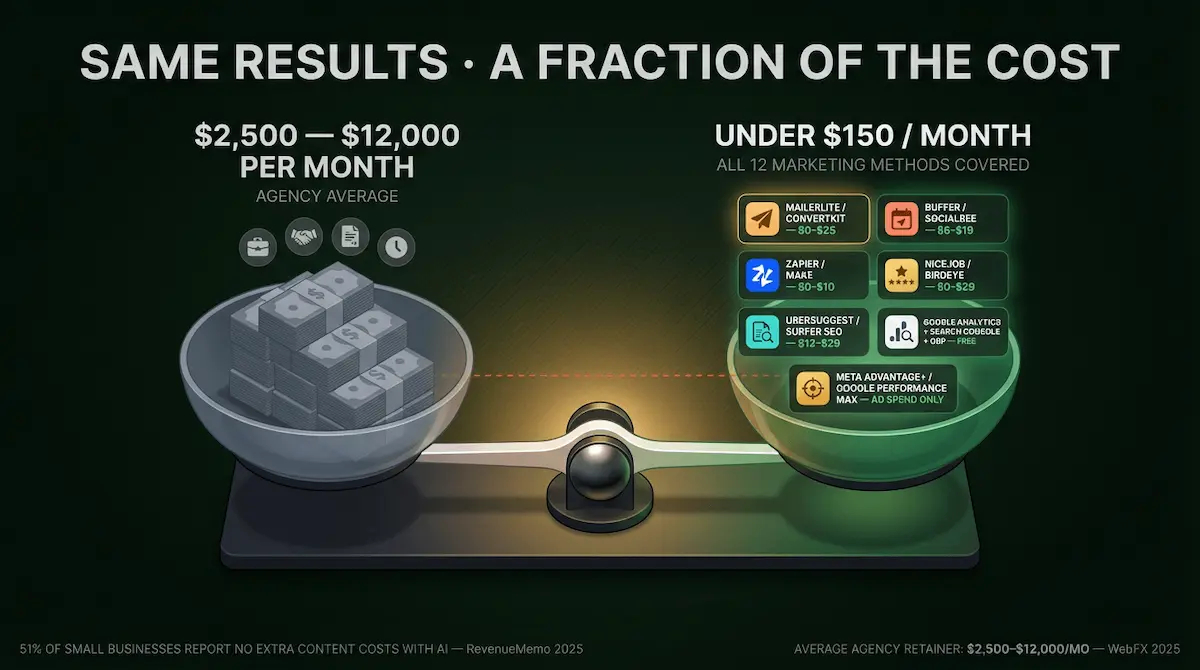
6) Your Lean Stack: Run All 12 Marketing Methods for Under $150 a Month
One of the most persistent myths I come across in conversations with small business owners is that building a professional, automated marketing operation requires a serious monthly budget. It does not. The twelve methods in this post — foundation, growth, and advanced layers combined — can be running simultaneously for less than most people spend on a single business dinner.
51% of small businesses say they incur no extra content marketing costs because they use AI tools Revenue Memo (RevenueMemo, 2025). The no-code revolution has done the same for automation. Tools that required enterprise budgets five years ago now have free tiers or starter plans priced for solopreneurs. The gap between what a one-person business can run and what a ten-person marketing team runs has never been smaller.
Here is the complete lean stack — every tool mapped to the methods it covers, with realistic pricing at the starter tier.
💰 Stack Snapshot — All 12 Methods. Under $150/Month.
Every tool below covers one or more of the 12 methods in this post.
| Tool | Methods Covered | Monthly Cost |
|---|---|---|
| MailerLite / ConvertKit | Email, Lead Magnet, Referral, Personalisation | $0–$25 |
| Buffer / SocialBee | Social Media, Short-Form Video scheduling | $6–$19 |
| Zapier / Make | Workflow Automation — connects entire stack | $0–$10 |
| NiceJob / Birdeye | Reviews, GBP management, Referral requests | $0–$29 |
| Ubersuggest / Surfer SEO | SEO, Content, Local SEO tracking | $12–$29 |
| Google Analytics + Search Console + GBP | Analytics, Local SEO, GBP optimisation | Free |
| Meta Advantage+ / Google Performance Max | AI-Assisted Paid Ads | Ad spend only — no platform fee |
| Total | $18–$112/month |
💡 Strategic partnerships cost nothing to execute. Short-form video requires only your phone. Both are zero-cost methods that sit inside this same stack.
What the Numbers Actually Mean
The industry average spend for an SMB working with a digital marketing agency runs between $2,500 and $12,000 per month (WebFX, 2025). The lean stack above replaces the foundational execution layer of that spend — email, social, SEO, automation, reviews — for a fraction of the cost. What you are not paying for is someone else's time. What you are getting instead is a system that runs those same functions automatically, on your behalf, around the clock.
The real investment in this stack is not financial. It is the four to six hours you put in upfront to build the workflows, write the sequences, and connect the tools. That is a one-time cost. Once the system is live, your ongoing commitment drops to a weekly content batch and a monthly review of what is performing.
I want to close this section with a perspective that I find useful when small business owners push back on the idea of building a system at all. The automation in email marketing tools that power this stack are not a shortcut. They are the infrastructure that allows one person to market like a team — consistently, intelligently, and without burning out.
The only thing this stack cannot do is make the decision to build it for you. That part is still on you.
You Have the Blueprint. The Vault Has Everything Else.
Most marketing advice ends with a list and a good luck. You now have something more useful than that — a complete, sequenced system covering twelve proven methods, three automation layers, a no-code tool stack, and a build order that prevents overwhelm. That is not nothing. That is the exact framework that separates small businesses that compound quietly in the background from those that stay stuck in the cycle of effort without momentum.
But I want to be direct with you about something, because I think it matters.
Reading the framework is not the same as having the system. Knowing what to build and actually having it built are two entirely different positions — and the gap between them is where most small business owners stall. Not because they lack ambition or intelligence. Because building everything from scratch, even with a clear roadmap, still takes time. Time to write the welcome sequences. Time to build the lead magnet. Time to create the referral email, the review request, the social content calendar, the automation workflows that connect them all together.
That is real time. Hours you could spend on your actual business.
What Vault AI Pro Members Skip Entirely
Here is what I want you to understand about what is waiting inside the Vault.
Every resource in this post — every sequence, every template, every workflow, every framework — exists inside Vault AI Pro as a ready-to-deploy, battle-tested asset. Not a rough draft. Not a generic starting point that still requires three hours of rework before it is usable. Done-for-you resources built specifically for entrepreneurs, solopreneurs, and small business owners who need professional-grade marketing systems without the professional-grade price tag.
The welcome sequence that turns cold subscribers into warm buyers? It is in there. The review request that consistently generates five-star Google reviews on autopilot? Built and ready. The referral email that gets sent automatically seven days post-purchase? Done. The lead magnet templates, the social content frameworks, the AI prompt library that handles your content creation in a fraction of the time? All of it — over 1,000 resources — updated weekly, inside one membership.
While other small business owners are spending their evenings building what already exists, Vault AI Pro members are deploying it.
One Decision. 100+ Hours Back Every Month.
Every hour you spend building a welcome sequence from scratch is an hour you did not spend serving clients, developing your offer, or simply not working. Marketing automation delivers $5.44 for every $1 invested — with 76% of companies seeing positive ROI within the first year Revenue Memo (Nucleus Research). But that return only arrives when the system is actually running. Not planned. Not half-built. Running.
That is the only variable left in this equation. You have the strategy. The system is built. The only question is whether you are going to spend the next four weekends building it yourself — or whether you are going to unlock it today, deploy it this week, and start getting time back instead of spending it.
10,000+ entrepreneurs have already made that decision.
Stop Building. Start Deploying.
1,000+ ready-to-deploy AI prompts, automation workflows, email sequences, lead magnet templates, referral systems, and content frameworks — built for entrepreneurs who want results, not more work.
Join 10,000+ entrepreneurs saving 3–5 hours every single day — that's 100+ hours back every month.
Unlock the Vault — Get Instant Access ➜Updated weekly. No tech skills needed. Cancel any time.