Email Marketing Marketing Automation: The Exact Integration Playbook for Entrepreneurs
Most entrepreneurs treat email marketing & marketing automation as two separate tools on two separate to-do lists. The ones scaling fastest in 2026 run them as one unified system — and this is the exact playbook showing how they do it.
Here is a question I ask every entrepreneur who tells me their email marketing is not working: are you sending emails, or are you running a system?
Most of the time, the answer is the first one. They have a list. They have a platform. They send something when they remember to, or when they have something to say, or when revenue dips and panic sets in. And then they wonder why email is not moving the needle the way everyone says it should.
The problem is almost never the emails. The problem is the absence of the intelligence layer sitting behind them.
Automated emails generate 320% more revenue than non-automated campaigns SalesHandy — and that gap is not about the quality of the writing. It is about the system. The combination of email marketing marketing automation is not a choice between two tools — it is a single revenue engine, and it only runs when both components ( email marketing + marketing automation) are properly connected.
The businesses scaling fastest in 2026 are not sending better emails than you. They have built a smarter architecture around their emails. They understand exactly where email marketing ends and where marketing automation begins — and they have wired the two together into one unified system that works without them.
This playbook is the exact guide to doing that. By the time you finish it, you will understand the precise distinction between the two, how to layer automation intelligence on top of your existing email marketing foundation, which five workflows to build first, how to choose the right platform for your stage, and how to tell — in under ten minutes — whether the integration is actually working.
The complete automation in marketing picture starts here — and this post is the chapter that connects your email list to your revenue engine.
1) Email Marketing vs Marketing Automation — The Distinction That Changes Everything
I want to start with the most common source of confusion I see among entrepreneurs building their first email system. They use "email marketing" and "marketing automation" interchangeably — as if they are two names for the same thing. They are not. And the moment you understand exactly where one ends and the other begins, the entire architecture of your revenue system clicks into place.
What Email Marketing Actually Is — And What It Is Not
Email marketing is the practice of sending messages to a list of subscribers with the goal of building a relationship, delivering value, or driving a specific action. A newsletter. A promotional campaign. A product announcement. A weekly roundup. These are all email marketing.
The defining characteristic is intentionality — a human decides what to send, to whom, and when. Email marketing is essentially a broadcast: one message going out to a defined audience at a chosen moment. It is enormously powerful on its own. Email delivers an average return of $36 for every $1 spent, making it the highest-performing digital marketing channel available Entrepreneurs HQ. But it has a ceiling — and that ceiling is you. Every email that goes out requires a decision, a draft, and a send. When you stop, it stops.
What Marketing Automation Actually Is — And Where Email Lives Inside It
Marketing automation is the system that removes you from that equation. It is the intelligence layer that decides — based on subscriber behaviour, timing, tags, and triggers — which email goes to which person at which exact moment, without you touching anything.
Email is the vehicle. Marketing automation is the engine deciding where that vehicle goes, when it departs, and who is in it.
Automated campaigns demonstrate 2,361% higher conversion rates than traditional campaigns Snovio — not because the emails are better written, but because they arrive at the precise moment a subscriber's behaviour signals readiness. The welcome email landing thirty seconds after someone opts in. The re-engagement sequence firing on day forty-five of silence. The nurture email delivering the case study the moment someone clicks your pricing page. None of that is possible with manual email marketing. All of it is possible with automation behind it.
The Gear Shift Moment — When One Becomes the Other
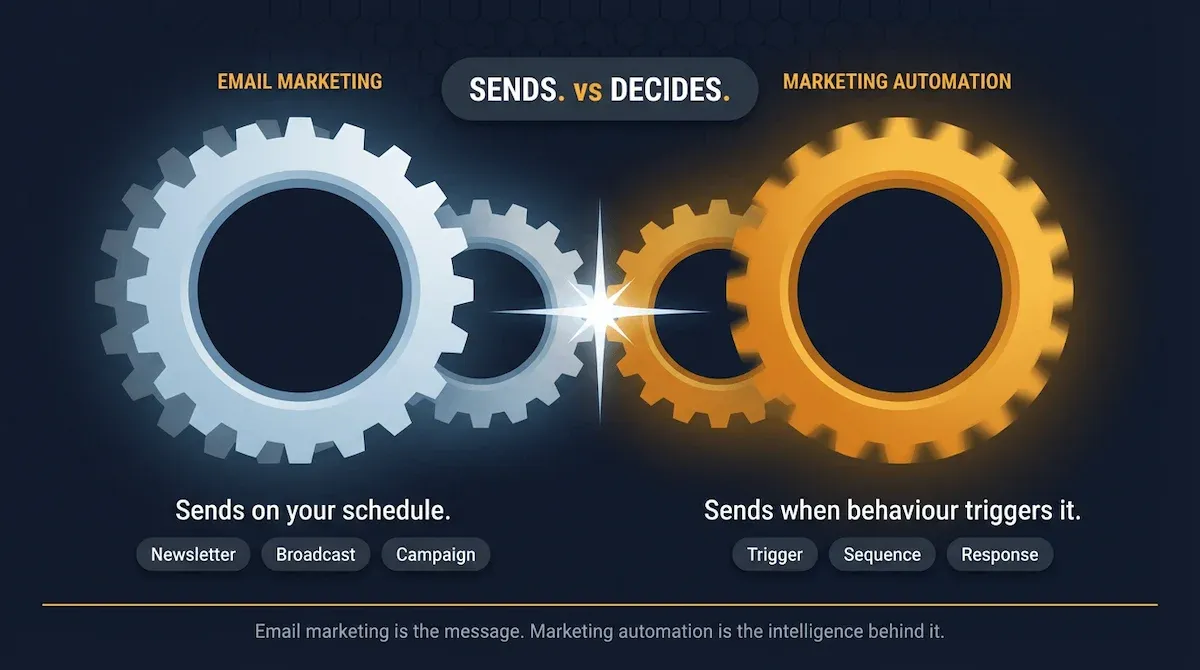
Here is the clearest way I can draw the line. If you scheduled it, it is email marketing. If a subscriber's action — or inaction — triggered it, it is marketing automation.
A promotional campaign you send every Tuesday is email marketing. A sequence that fires when someone downloads your lead magnet is marketing automation. A newsletter you broadcast to your full list is email marketing. A three-part sequence that only reaches subscribers who clicked a specific link is marketing automation.
🎯 THE ONE-LINE DISTINCTION
Email marketing sends. Marketing automation decides.
One is the message. The other is the intelligence behind when that message is sent, to whom, and why. You need both — and they only perform at their ceiling when they are running as one connected system.
Most entrepreneurs reading this have the first gear running. Some have built pieces of the second. Very few have connected them deliberately — which is exactly why the revenue gap between those two groups keeps widening in 2026. Understanding how automation in email marketing works as a standalone discipline is the foundation — but Section 2 shows you precisely what that gap is costing you in real revenue terms.
2) Why Running Email Marketing Without Marketing Automation Is Leaving Money on the Table
Let me give you a number that should make every entrepreneur running manual email campaigns deeply uncomfortable.
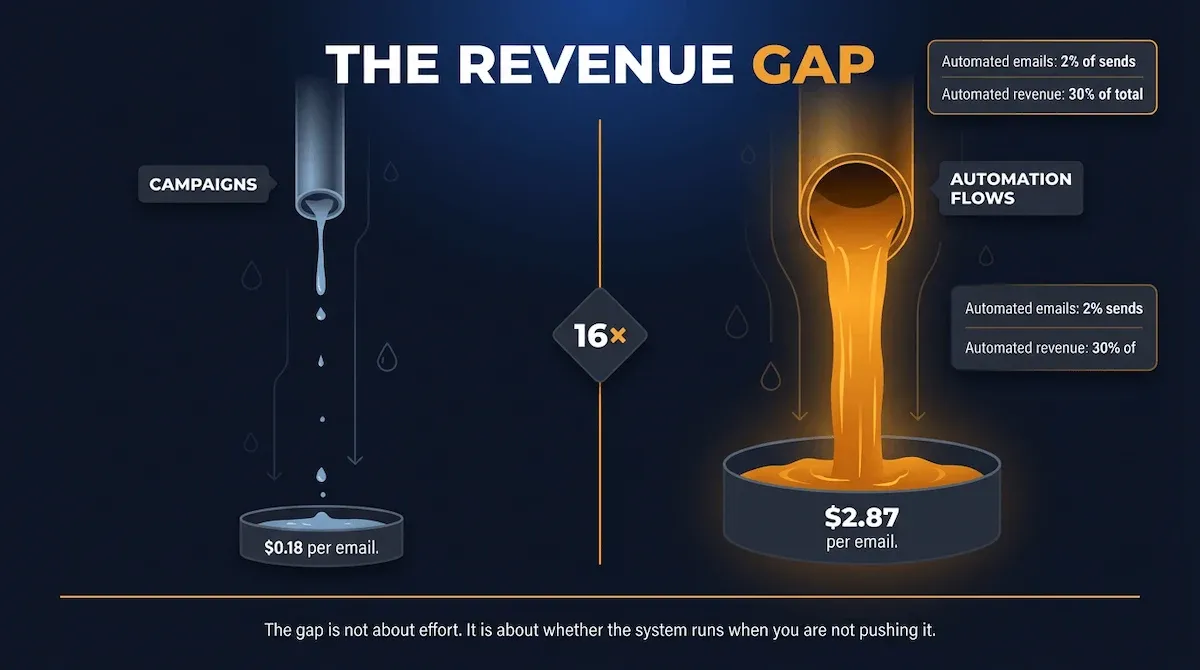
Automated emails account for just 2% of total email sends — yet they drive 30% of all email revenue, generating $2.87 per email compared to $0.18 for standard campaigns. Omnisend Read that again. Two percent of the sends. Thirty percent of the revenue. The math on that gap is not a rounding error — it is a structural problem in how most small businesses are approaching their email strategy.
The Revenue Gap — What the Data Actually Shows
I want to put that gap in terms that hit closer to home. Imagine you have 1,000 subscribers. You send a broadcast campaign every two weeks — reasonably well-written, good open rate, you feel okay about it. At $0.18 per email, that campaign generates $180. Now imagine that same list, same subscribers, with a properly configured automation layer behind it. The same 1,000 people entering a welcome series, a nurture drip, a re-engagement sequence. At $2.87 per automated email across those flows, the same list is generating sixteen times more revenue — not because you wrote better emails, but because the intelligence layer is deciding who gets what, and when.
The top 10% of email workflows generate $16.96 in revenue per recipient, while average email flows generate $1.94 Brevo — both figures dwarfing what manual campaigns produce. The ceiling on your email marketing is not your writing ability or your list size. It is the absence of automation running underneath it.
The Three Things Manual Email Marketing Can Never Do
This is where the gap becomes structural rather than just statistical. No matter how disciplined you are about sending, manual email marketing cannot do three things that automation handles by default.
It cannot respond to individual behaviour in real time. When a subscriber visits your pricing page three times in two days and then goes silent, manual email marketing has no mechanism to notice that and act on it. Automation does — and it fires the follow-up within hours, not weeks.
It cannot maintain a consistent relationship with every subscriber simultaneously. The moment your list grows past a few hundred people, the idea of personally nurturing each subscriber through a thoughtful sequence becomes fiction. Automation maintains that relationship with every single person, at every stage, without you scaling your effort by a single hour.
It cannot convert during the moments you are not working. Your highest-converting email window — the first 24 hours after a new subscriber joins your list — happens at all hours, on weekends, during holidays. Manual sending misses most of it. Automation never does.
The Exact Moment to Add Automation to Your Email Marketing Strategy
⚡ THE AUTOMATION TIPPING POINT
| Signal | What It Means | First Automation to Build |
|---|---|---|
| You have 100+ subscribers | Manual nurturing is already impossible | Welcome series — 3 emails, 5 days |
| You have a lead magnet | Every download is a warm lead going cold | Lead magnet delivery + 2-email follow-up |
| You sell a service or product | Post-purchase silence is killing LTV | Post-purchase sequence — 4 emails, 21 days |
| You haven't emailed in 2+ weeks | Your list is going cold right now | Re-engagement sequence — 3 emails, 14 days |
The honest answer to "when should I add automation?" is: the moment you had your first subscriber, you were already past the tipping point. The second-best time is today. Every week you run email marketing for business without the automation layer is a week you are generating $0.18 per email instead of $2.87. That gap compounds quietly — and by the time most entrepreneurs notice it, they have left thousands of dollars on the table. Section 3 gives you the exact framework for building the integration that closes it.
3) The Email Marketing Marketing Automation Integration Framework
I want to be direct about something most automation guides get wrong.
They treat email marketing and marketing automation as a single tool with a single on/off switch. Turn it on, watch the revenue flow. That is not how it works — and when entrepreneurs build their systems with that mental model, they end up with a patchwork of sequences that fire at the wrong times, to the wrong people, with no logical connection between what they send and what a subscriber actually did to receive it.
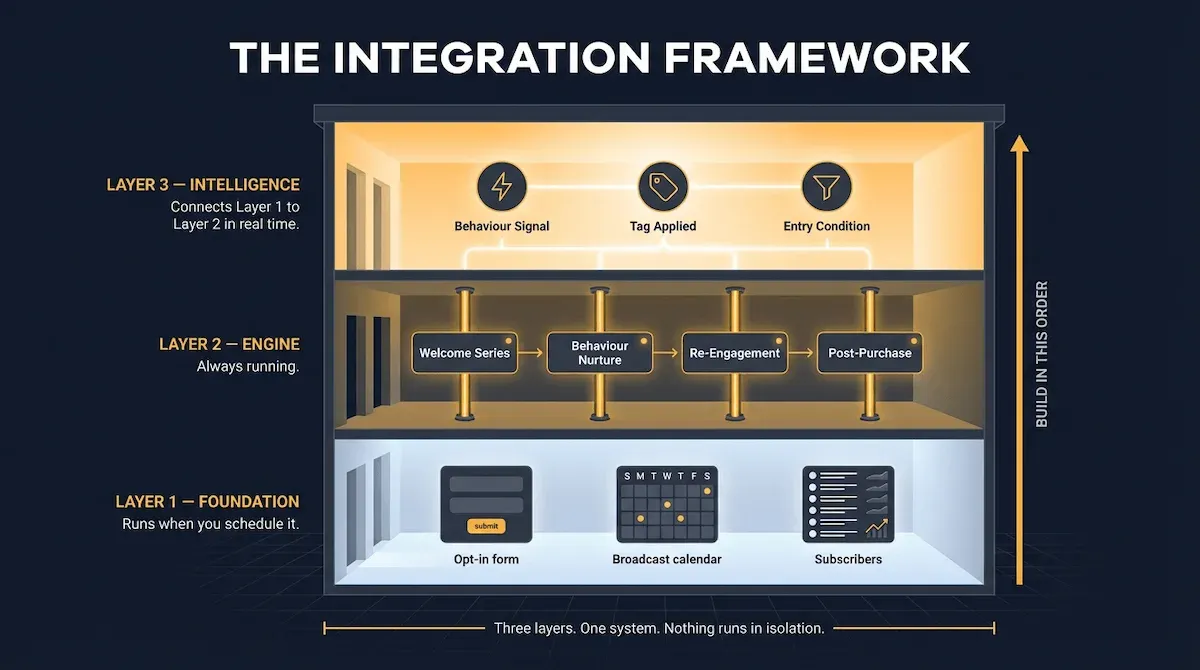
The integration framework I use — and the one I see working consistently across different business types — breaks the system into three distinct layers. Each layer has a specific job. Each layer feeds the next. None of them work well in isolation.
Layer One: The Foundation
This is your email marketing layer. It includes your list, your opt-in forms, your lead magnets, and your broadcast campaigns. Everything in Layer One runs on a schedule you set. You write a newsletter, you pick a send date, you hit publish. It is deliberate, editorial, and entirely under your control.
Most entrepreneurs have Layer One and nothing else. They built a list, they send campaigns when they have something to say, and they wonder why their revenue is inconsistent. Layer One alone will always produce inconsistent revenue — because it only works when you are actively working it.
Layer Two: The Engine
This is your marketing automation layer. Welcome sequences, nurture tracks, re-engagement campaigns, post-purchase follow-ups — these run independently of anything you do on a given Tuesday. I think of Layer Two as the part of the business that earns money while you are doing something else entirely.
The sequences inside Layer Two are built once and refined over time. They are not campaigns. They are infrastructure. Advanced automation paired with behavioural triggers converts at 451% higher rates than batch-and-blast campaigns La Growth Machine — and that gap exists entirely because Layer Two is responding to what subscribers actually do, not what you guessed they might want when you scheduled a broadcast two weeks ago.
Layer Three: The Intelligence Layer
This is where most entrepreneurs stop building, and it is the most expensive mistake they make.
Layer Three is the system of triggers, tags, and segment rules that connect Layer One and Layer Two in real time. Without it, your foundation and your engine exist as two separate things that never talk to each other. With it, every action a subscriber takes — clicking a link, visiting a pricing page, downloading a resource, going quiet for 30 days — feeds a signal that moves them automatically into the right sequence at the right moment.
Here is what that looks like in practice. A subscriber opens your weekly newsletter and clicks a link about pricing. That click fires a tag. The tag triggers entry into a high-intent nurture sequence. Four emails later, they book a call. None of that required you to notice the click, make a decision, or write a single new email in the moment. The system noticed. The system responded.
✅ THE THREE-LAYER INTEGRATION FRAMEWORK
| Layer | What Lives Here | Job | Runs When |
|---|---|---|---|
| Layer 1 — Foundation | List, forms, lead magnets, broadcasts | Build audience, stay visible | You schedule it |
| Layer 2 — Engine | Welcome, nurture, re-engagement, post-purchase sequences | Convert and retain automatically | Always |
| Layer 3 — Intelligence | Triggers, tags, segment rules, entry conditions | Connect Layer 1 to Layer 2 in real time | Subscriber takes action |
The order matters. I always tell entrepreneurs to build in sequence: get Layer One clean before you automate anything, build Layer Two before you obsess over triggers, then wire up Layer Three once you have something worth connecting. Entrepreneurs who try to build all three simultaneously almost always end up with none of them working properly.
What this framework produces — when all three layers are running — is a system where your broadcasts feed your automations, your automations respond to subscriber behaviour, and none of it requires you to make a decision in real time. That is the actual definition of email marketing marketing automation working as an integrated system rather than two tools running in parallel.
The next section maps the five specific automation workflows that live inside Layer Two — the ones I consider non-negotiable for any entrepreneur running this system seriously.
4) The 5 Automation Workflows Every Email Marketing System Needs Running Right Now
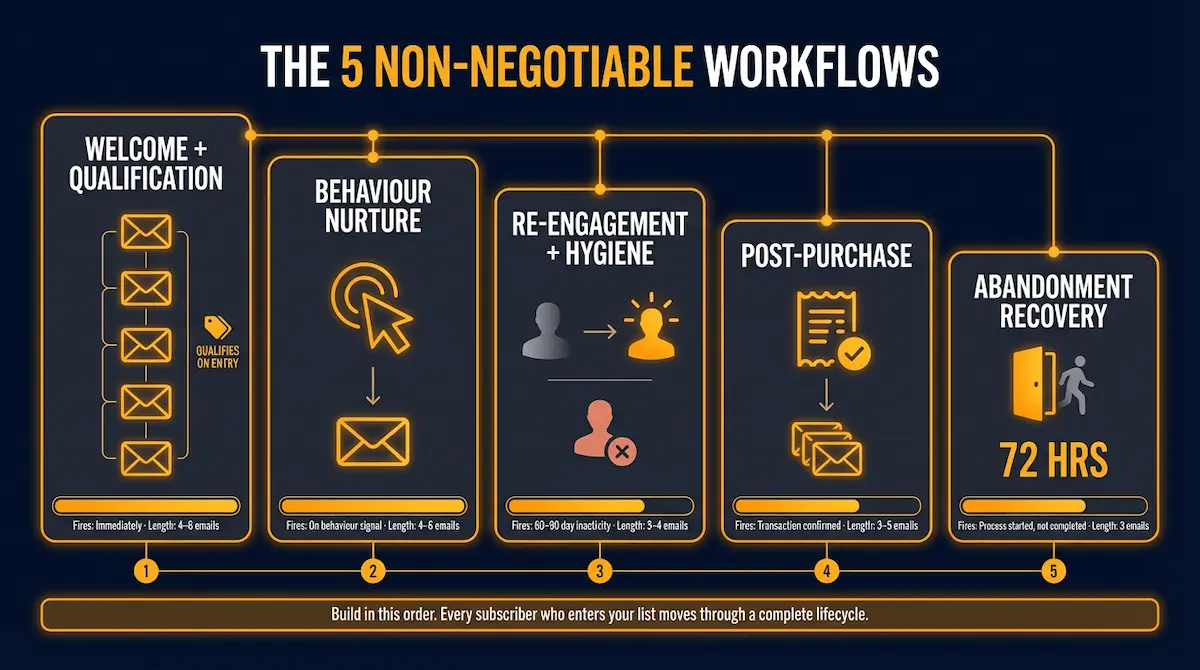
I am going to give you the five workflows I consider non-negotiable. Not ten. Not fifteen. Five — because most entrepreneurs who fail at this fail because they tried to build everything at once and ended up with nothing actually running.
Get these five live. In this order. Everything else can come later.
Workflow 1 — The Welcome + Qualification Sequence
This is the highest-leverage automation in your entire system, and most entrepreneurs either skip it entirely or send a single "thanks for subscribing" email and call it done.
Here is what that costs them. According to Klaviyo's 2025 benchmarks, welcome sequences average a 51% open rate, with top-performing series hitting click rates of 15% and placed order rates of nearly 10%. Klaviyo That is not a warm-up sequence. That is a revenue sequence. And it fires at the exact moment a subscriber is most curious and most engaged — within the first 48 hours of joining your list.
A proper welcome sequence does two things simultaneously: it introduces your brand and immediately qualifies the subscriber. Four to six emails over seven to ten days. The first email delivers whatever you promised (the lead magnet, the resource, the discount). The second tells the story — who you are, what problem you solve, why it matters. Emails three and four drive a specific action: click a link, answer a question, visit a page. Those actions generate tags. Those tags determine which sequence the subscriber enters next.
That last part is where most welcome sequences stop being welcome sequences and start being an actual system.
Workflow 2 — Behaviour-Triggered Nurture
This is Layer Three from the previous section doing its job. A subscriber clicks your pricing page link in your newsletter. A tag fires. They enter a high-intent nurture sequence — four to six emails that address objections, share case studies, and move toward a conversion event.
A subscriber clicks a link about a specific topic three weeks in a row. That pattern fires a tag. They enter a content-preference nurture track that sends them exactly more of what they kept clicking on.
I consider this the most profitable workflow in the system — not because the individual emails convert spectacularly, but because they convert the right people at the right moment. Behaviour-triggered sequences deliver 152% higher click-through rates than standard campaigns Landbase, and the reason is simple: the subscriber's own action told you exactly what they wanted. You did not guess.
Workflow 3 — Re-Engagement + List Hygiene
Every list goes cold. It is not a failure — it is a feature of how humans interact with email. The mistake is letting cold subscribers sit indefinitely, dragging down your open rates, damaging your sender reputation, and quietly making every other sequence perform worse than it should.
A re-engagement sequence runs automatically when a subscriber has not opened or clicked in 60 to 90 days. Three to four emails. A direct subject line — "Are we still good?" works better than you think. A reason to come back. A clear exit: if they do not engage with this sequence, they are unsubscribed automatically.
I know the idea of automatically removing subscribers feels uncomfortable. But a list of 4,000 engaged contacts will always outperform a list of 12,000 mixed contacts on every metric that matters — deliverability, open rate, conversion rate, and cost.
Workflows 4 and 5 — The Revenue Workflows
These two depend on your business model, but the logic is identical for both.
If you sell products or services: a post-purchase sequence fires immediately after a transaction. It confirms the purchase, sets expectations, delivers value, and introduces the next logical offer three to five days later. To'ak Chocolate, for example, reports nearly 40% of all email revenue coming from automated sequences alone Omnisend — and post-purchase automation is where a significant portion of that compounds.
If you sell via application, booking, or consultation: an abandonment sequence fires when someone starts a process and does not complete it. They visited your booking page. They did not book. An email goes out within two hours. Another follows 24 hours later. A third closes the loop at 72 hours with a different angle or a specific objection addressed.
Both workflows share the same principle: the subscriber told you exactly where they were in their decision. Your automation responded to that signal before you even knew it happened.
🎯 THE 5 NON-NEGOTIABLE WORKFLOWS — BUILD IN THIS ORDER
| # | Workflow | Trigger | Length | Primary Job |
|---|---|---|---|---|
| 1 | Welcome + Qualification | New subscriber joins list | 4–6 emails / 7–10 days | Introduce, qualify, tag |
| 2 | Behaviour-Triggered Nurture | Link click / page visit / tag applied | 4–6 emails / 14 days | Convert intent into action |
| 3 | Re-Engagement + Hygiene | 60–90 days no open or click | 3–4 emails / 10 days | Win back or remove cleanly |
| 4 | Post-Purchase Follow-Up | Transaction confirmed | 3–5 emails / 14 days | Retain, upsell, generate referrals |
| 5 | Abandonment Recovery | Process started, not completed | 3 emails / 72 hours | Recover lost revenue |
Once these five are running, your email marketing marketing automation system has a complete lifecycle — acquisition, nurture, conversion, retention, and recovery. Every subscriber who enters your list moves through a logical sequence based on what they do, not what you hope they will do.
The next question most entrepreneurs hit at this point is the platform question — because not every tool handles all five of these workflows equally well. That is exactly what Section 5 covers.
5) How to Choose the Right Email Marketing and Marketing Automation Platform in 2026
The platform question is where I see entrepreneurs waste the most time. They spend weeks reading comparison articles, watching demo videos, signing up for five trials simultaneously, and end up either picking the most popular name they recognise or the cheapest option they can find. Neither decision is based on what actually matters.
What matters is one question: does this platform support all five workflows from Section 4 without requiring a developer to build them?
That is the filter. Everything else — the drag-and-drop editor, the template library, the AI subject line generator — is a feature. Supporting your complete email marketing marketing automation system is a requirement. Those are different categories, and conflating them is how entrepreneurs end up paying for a platform that handles their broadcasts beautifully but breaks down the moment they try to build a behaviour-triggered nurture sequence.
Let me walk you through the decision framework I use, structured around the three business stages where entrepreneurs actually are — not the idealised stages that platform comparison sites assume they are.
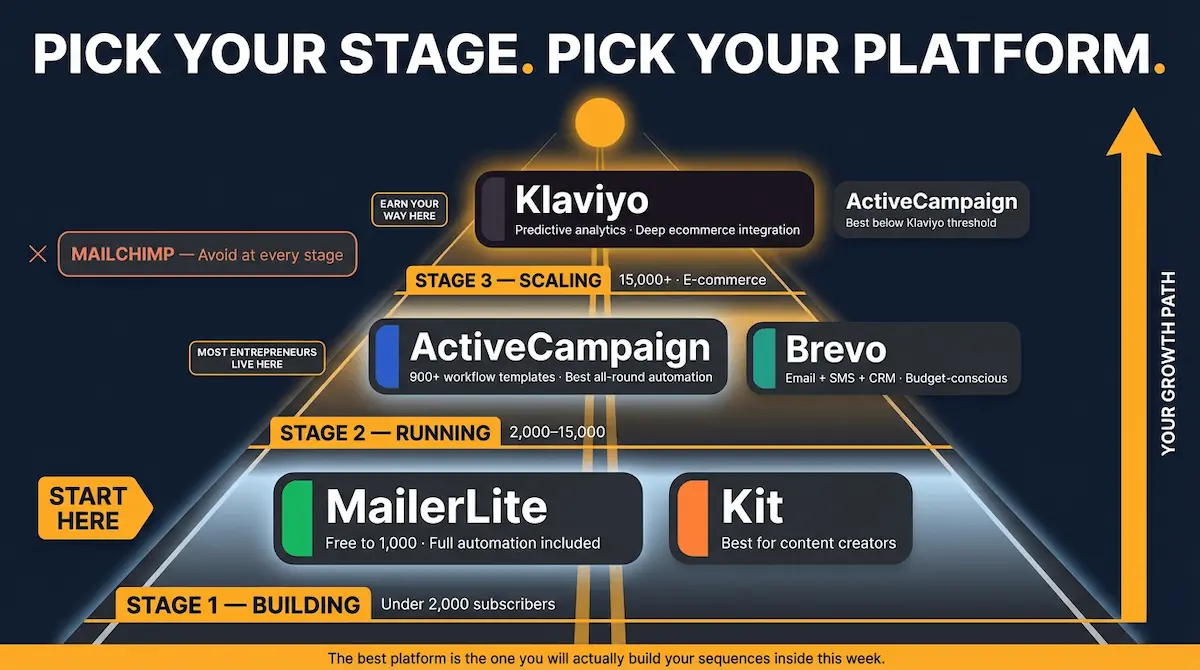
Stage One: You Are Building the Foundation (Under 2,000 Subscribers)
At this stage, the goal is to get the welcome sequence and the re-engagement workflow live without spending money you do not have on features you are not using yet.
MailerLite is the platform I recommend here without hesitation. MailerLite's free plan sends up to 12,000 emails per month to 1,000 subscribers, supports multi-trigger automations, and includes a landing page builder Campaign Monitor — which means you can have your entire Layer One and Layer Two infrastructure live before you spend a single dollar. The interface is clean, the automation builder is visual and genuinely intuitive, and the upgrade path is predictable.
Kit (formerly ConvertKit) is the alternative if your business model is content-first — courses, newsletters, digital products. The tag and segment system is built with creators in mind, and the subscriber management logic is cleaner than MailerLite for list-centric businesses.
What to avoid at this stage: Mailchimp. In independent 90-day testing, Mailchimp returned an 82% inbox placement rate — below every meaningful competitor — while pricing at 2 to 3 times the cost of equivalent platforms. La Growth Machine Brand recognition is not a substitute for deliverability.
Stage Two: You Are Running the System (2,000–15,000 Subscribers)
This is where the platform decision gets genuinely consequential. You have sequences running. You have subscribers moving through them. You need the intelligence layer — the triggers, the conditional logic, the segment rules — to actually work without manual workarounds.
ActiveCampaign is the platform I point to at this stage for most entrepreneurs. It carries over 900 customisable automation workflow templates and is consistently rated the strongest all-round performer at the intersection of email marketing and CRM integration. Brevo The visual workflow builder handles conditional branching, lead scoring, and multi-step sequences without requiring you to think in code. The learning curve is real — plan two to four weeks to feel genuinely fluent — but the capability ceiling is high enough that most entrepreneurs never hit it.
Brevo is the budget-conscious alternative at this stage. It combines email, SMS, and CRM features in a single platform at pricing that makes ActiveCampaign look expensive Campaign Monitor, and for entrepreneurs who need multi-channel touchpoints without juggling separate tools, the value proposition is difficult to argue with.
Stage Three: You Are Scaling Revenue (15,000+ Subscribers or E-commerce)
If you are running an e-commerce business and email drives a meaningful percentage of revenue, one platform pulls ahead of everything else at scale.
Klaviyo is built for this scenario specifically. Its deep data integration, predictive analytics, and multi-channel orchestration make it the strongest option for online stores focused on customer retention and lifetime value. Campaign Monitor The post-purchase sequences, the abandonment flows, the predictive send-time optimisation — all of it connects to your store data natively in ways that other platforms handle through integrations that occasionally break.
The honest caveat: Klaviyo gets expensive quickly as your list grows, and the setup complexity is real. Independent analysis suggests waiting until email drives at least 15% of monthly revenue before the pricing is justified La Growth Machine — below that threshold, Omnisend or ActiveCampaign deliver comparable results at significantly lower cost.
⚡ PLATFORM DECISION FRAMEWORK — MATCH YOUR STAGE
| Stage | Subscribers | Best Pick | Alternative | Avoid |
|---|---|---|---|---|
| Building | Under 2,000 | MailerLite | Kit | Mailchimp |
| Running | 2,000–15,000 | ActiveCampaign | Brevo | Mailchimp |
| Scaling | 15,000+ / E-com | Klaviyo | ActiveCampaign | Over-investing early |
One final point that no platform comparison article ever leads with: the best platform is the one you will actually build your sequences inside this week. A perfect platform with no workflows running beats nothing. An adequate platform with all five sequences live beats a perfect platform sitting in a browser tab you have not opened since March.
Pick your stage. Pick your platform. Build the system. The metrics to tell you whether it is working come next.
6) The Email Marketing Marketing Automation Metrics That Tell You the Integration Is Working
Here is the mistake I see constantly: entrepreneurs build the sequences, get them running, and then check the wrong numbers to decide whether the system is working.
They look at open rates because open rates are the first thing every email platform puts in front of you. They see 30% and feel reassured. Or they see 22% and feel anxious. Either way, they are measuring the wrong thing — because open rates tell you whether your subject lines are working, not whether your email marketing marketing automation system is generating revenue.
The metrics that tell you the integration is actually working are different. They are fewer, they are more specific, and they map directly to the three-layer framework from Section 3. Here is what I track, and what each number is actually telling you.
Metric 1 — Revenue Per Recipient (Your System's North Star)
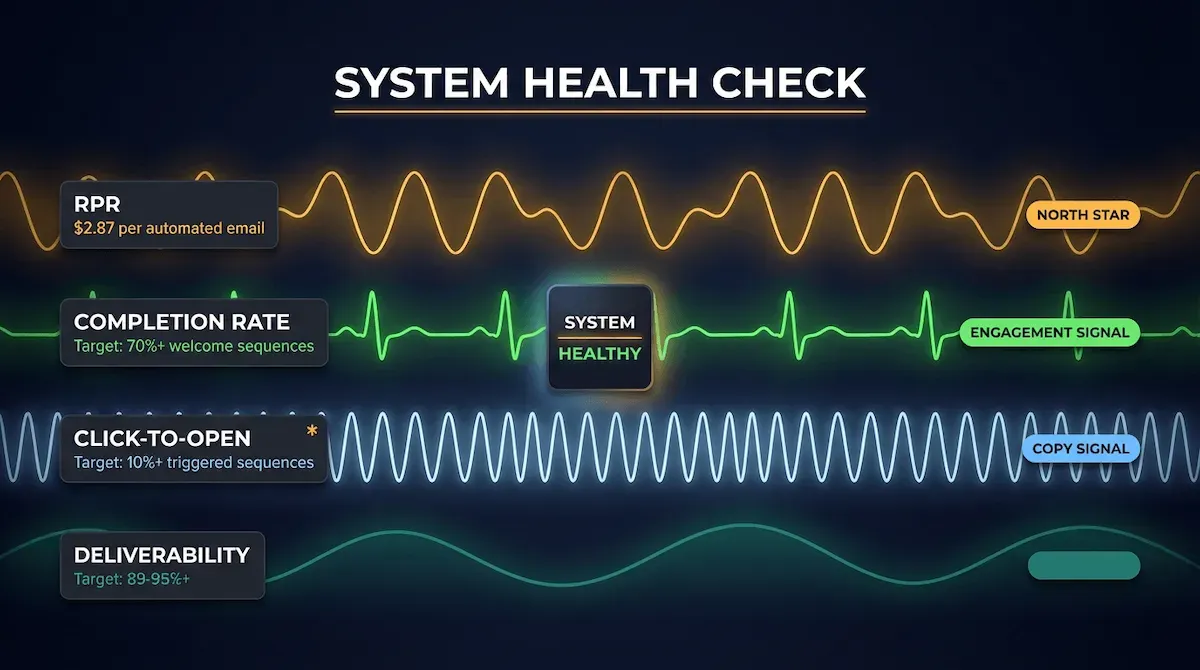
Revenue per recipient — RPR — is the single number that tells you whether your automation is doing its job. It measures how much revenue your email system generates per subscriber per send, and it separates automated flows from broadcast campaigns in a way that open rates never can.
Klaviyo's 2026 benchmark data across 183,000 customers shows that email flows generate nearly 41% of total email revenue from just 5.3% of total sends, with average revenue per recipient nearly 18 times higher than campaigns. Klaviyo That gap — 18 times — is not a rounding error. It is the difference between a system running and a list sitting.
For entrepreneurs starting out, a healthy RPR benchmark for automated flows sits between $1.50 and $3.00 per recipient. Top 10% performers reach RPR as high as $7.79 Klaviyo, driven by sophisticated segmentation and well-timed behavioural triggers. If your RPR on automated sequences is below $1.00, the sequences are running but the targeting or the offer is off. That is a diagnosis, not a verdict — and it points you directly to what needs fixing.
Metric 2 — Sequence Completion Rate (Your Engagement Diagnostic)
Sequence completion rate tells you what percentage of subscribers who enter a sequence actually receive all of it — rather than unsubscribing, going cold, or being removed mid-flow.
A healthy welcome sequence completion rate sits above 70%. If yours is at 40%, something is breaking in the middle of the sequence — either the email three or four is hitting the wrong note, the send cadence is too aggressive, or the sequence entered the wrong subscriber in the first place. That last cause is a Layer Three problem: your triggers are not qualifying people correctly before entry.
I pay close attention to this metric on re-engagement sequences specifically, because that is where the system actively removes subscribers who are not completing. A re-engagement completion rate of 30 to 40% is not a failure — it means the sequence is doing its job, which is to either re-engage or cleanly exit people who were dragging down your deliverability.
Metric 3 — Click-to-Open Rate (Your Copy and Relevance Signal)
Open rates are unreliable in 2026. Apple's Mail Privacy Protection has inflated them artificially since 2021, and the 2025 industry average open rate across all sectors sits at 43.46% MailerLite — a number that includes a significant percentage of phantom opens registered by Apple's pre-loading behaviour.
Click-to-open rate — CTOR — is the metric that cuts through that noise. It measures the percentage of people who opened your email and then clicked something inside it. It is a pure signal of whether your content matched what the subject line promised. The 2025 average CTOR sits at 6.81% MailerLite, up from 5.63% the prior year. Automated sequences should outperform that figure meaningfully — a CTOR of 10% or above on a behaviour-triggered nurture sequence tells you the content is landing on the right people at the right moment.
If your CTOR is below 5% on a triggered sequence, the sequence is reaching people but the content is not matching their intent. That is a content fix, not a system fix. The trigger is working. The email is not.
Metric 4 — Deliverability Rate (The Silent Killer)
None of the other three metrics matter if your emails are landing in spam. Deliverability is the foundation everything else sits on, and it is the metric most entrepreneurs check last — usually after something has already gone badly wrong.
A deliverability rate above 89% is considered good; above 95% is excellent. ActiveCampaign If yours drops below 85%, the culprit is almost always one of three things: list hygiene (too many inactive subscribers dragging your sender reputation down), authentication (SPF, DKIM, and DMARC not properly configured), or engagement drop (too many people marking emails as spam because the sequences are firing at the wrong time or to the wrong segment).
The re-engagement workflow from Section 4 is the single most important thing you can do to protect deliverability over time. A clean list of engaged subscribers is not just a vanity metric — it is the technical infrastructure that keeps every other sequence in your system performing.
✅ EMAIL MARKETING AUTOMATION HEALTH CHECK
| Metric | Healthy | Warning | Fix First |
|---|---|---|---|
| Revenue Per Recipient | $1.50–$3.00+ (flows) | Below $1.00 | Offer timing or targeting |
| Sequence Completion | 70%+ (welcome) | Below 50% | Email 3–4 content or send cadence |
| Click-to-Open Rate | 10%+ (triggered) | Below 5% | Content relevance to trigger |
| Deliverability Rate | 89–95%+ | Below 85% | List hygiene + authentication |
The discipline here is checking these four numbers on a fixed schedule — not when something feels wrong. RPR and sequence completion monthly. CTOR weekly on active sequences. Deliverability after every major send. That cadence turns your metrics from a report card into an early warning system.
When all four are healthy, you are not guessing whether your email marketing marketing automation integration is working. The numbers are telling you directly. And when one of them dips, you know exactly which layer of the system to open up and fix — without tearing apart everything else to find it.
The conclusion brings this all together into the one decision that separates entrepreneurs who read about this from the ones who actually have it running.
You Now Have the Playbook. The Only Question Is What You Do With It.
Most entrepreneurs who read something like this do one of two things.
They bookmark it. They tell themselves they will come back to it this weekend, or next week when things quiet down, or once they have sorted out the other twelve things sitting in their to-do list. And the bookmark sits there. The sequences never get built. The system never runs. Twelve months later they are still sending the same manual newsletter to the same list, wondering why revenue feels so unpredictable.
Or they build it.
Not perfectly. Not all at once. They start with the welcome sequence because that is Workflow 1 for a reason — it is the highest leverage, the easiest to build, and the one that starts earning the moment it goes live. Then they add the behaviour triggers. Then the re-engagement workflow. Three months later they have a system that runs independently of how many hours they worked that week.
The gap between those two people is not talent. It is not budget. It is not even time.
It is whether they had everything ready to go the moment they decided to start.
What Vault AI Pro Members Skip Entirely
The part of this process that kills momentum is not the strategy. You have the strategy. You just read it.
The part that kills momentum is the build. Sitting down to write a six-email welcome sequence from scratch. Trying to remember the right trigger logic for a behaviour-triggered nurture track. Staring at a blank workflow canvas inside ActiveCampaign at 9pm on a Tuesday wondering whether you are configuring this correctly.
Inside Vault AI Pro, none of that exists. Every workflow in this playbook is pre-built and ready to deploy. The welcome sequence. The behaviour-triggered nurture tracks. The re-engagement flow. The post-purchase follow-up. The abandonment recovery. All five. Done.
Beyond the workflows, members get the full automation prompt library — so every email inside those sequences can be written in minutes, not hours. The segmentation playbook that maps exactly which tags to apply and when. And the metrics dashboard template from Section 6, pre-formatted so you can plug in your numbers and know what is working the moment your sequences go live.
The average Vault AI Pro member saves 3 - 5 hours every single day. Not because they stopped doing the work. Because they stopped starting from scratch every time.
One Decision. Everything Ready. Your Sequences Live This Week.
You do not need another month of research. You do not need a bigger list or a bigger budget. You need the five workflows built, connected, and running — and that decision takes about thirty seconds.
Stop Building From Scratch.
Your Entire Email System Is Already Done.
Every workflow, sequence, trigger, and template from this playbook — pre-built, ready to deploy, and waiting inside the Vault.
abandonment
🔒 Instant access · Cancel anytime · Used by 10,000+ entrepreneurs
Replaces $50/hr freelancer work · Saves 3 - 5 hours every single day · Instant ROI