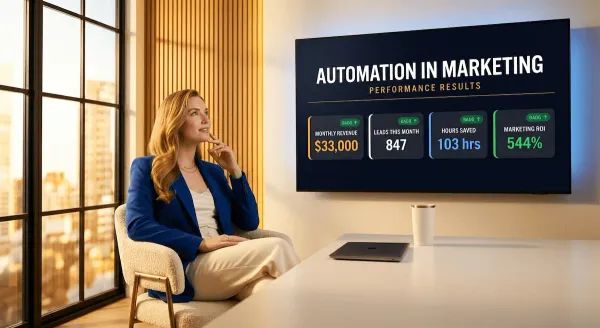
Email Marketing for Business in 2026: What Actually Works, What to Automate, and What to Stop Doing Immediately
Most small businesses do email marketing. Almost none do it as a system. This guide covers what actually works in 2026, what to automate, and what to stop doing immediately — the complete playbook for an email engine that runs without you.

Here is a number you have probably seen before: $36 returned for every $1 spent. It gets quoted in every email marketing article, every platform landing page, and every "why you should start an email list" post on the internet. And yet, when I talk to small business owners who have been sending emails for months — sometimes years — most of them are nowhere near that number. Open rates are flat. Click rates are disappointing. Revenue from email is either inconsistent or completely invisible.
The problem is not email marketing for business. The channel works. The problem is that most small business owners are doing email marketing like it is 2015 — sending manual newsletters whenever they remember, blasting their entire list with the same message, and measuring success by whether the open rate went up or down. That approach was average then. In 2026, it is the reason your results have stalled.
I have seen the difference up close. The entrepreneurs who consistently earn outsized returns from email are not the ones with the biggest lists or the most expensive platforms. They are the ones who stopped treating email as a campaign and started treating it as a system — built once, automated completely, and running in the background while they focus on everything else. If you want to understand how that system fits into your broader marketing engine, our guide to automation in marketing covers the full picture.
That is exactly what this guide is going to show you. What actually works in 2026 — not trends, not theory, but the specific email types that drive revenue. What to automate — the six sequences that handle your email marketing without a single manual send. And what to stop doing immediately — the seven mistakes that are quietly destroying results for most small businesses right now.
Whether you have 50 subscribers or 5,000, the system is the same. Let us build it.
1) What Email Marketing for Business Actually Means in 2026 — And What Most Owners Get Wrong
I want to start with a distinction that most email marketing guides skip entirely — because they assume you already understand it. You probably do not, and that is not a criticism. Nobody explained it clearly enough.
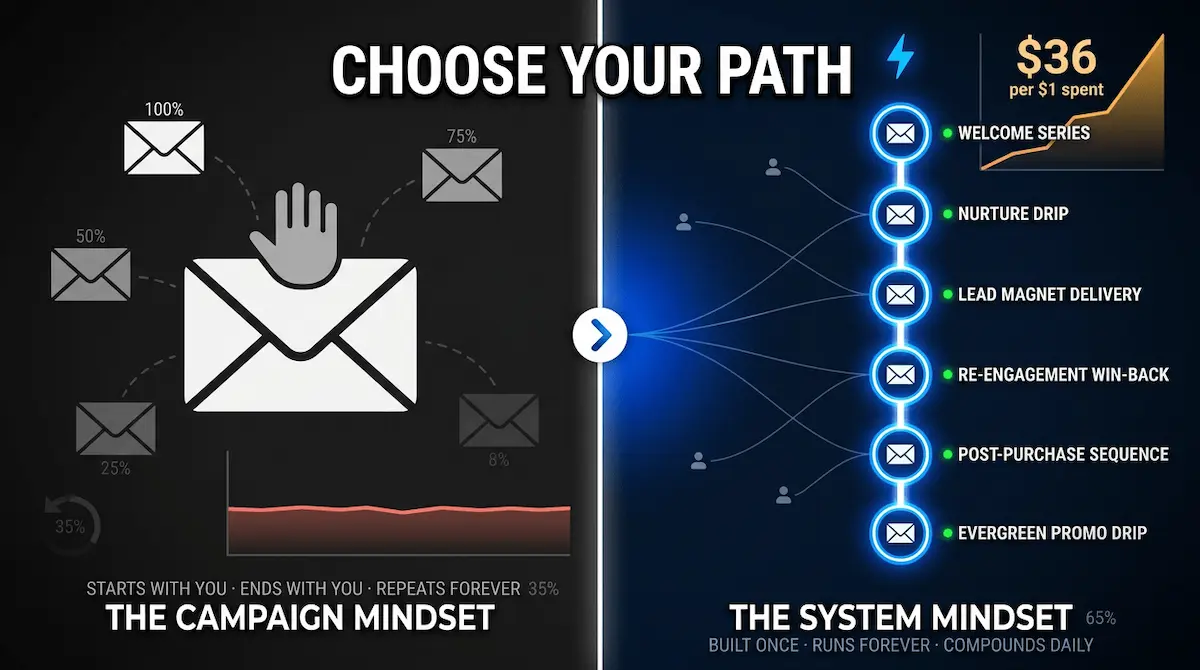
There are two completely different ways to do email marketing. The first is what most small business owners are doing. The second is what the ones seeing $36 ROI are doing. The difference between them is not budget, list size, or platform. It is mindset — and the system that mindset produces.
The Campaign Mindset That Is Holding You Back
The campaign mindset treats email like a megaphone. You have something to say, you write an email, you send it to your list, you watch the open rate, you feel vaguely disappointed, and you repeat the process two weeks later when you remember to. Every email requires your direct involvement. Every send starts from scratch. The moment you stop creating, the channel stops producing.
This is how the vast majority of small business owners approach email marketing. I know because I have spoken to hundreds of them. They are not lazy or unstrategic — they are simply operating a model that was never designed to scale. And in 2026, with 4.7 to 4.8 billion global email users and approximately 392 billion emails sent daily Mailjet, the campaign mindset does not just underperform. It makes you invisible.
The System Mindset That Changes Everything
The system mindset treats email like a machine. You build it once, you connect the right triggers, and it runs — welcoming new subscribers, nurturing cold leads, recovering abandoned enquiries, re-engaging dormant contacts, and generating repeat purchases — without you touching it again. The emails go out whether you are working, sleeping, or on holiday. The revenue they generate does not depend on whether you remembered to write something this week.
This is not complicated. It does not require an enterprise platform or a dedicated marketing team. It requires understanding which sequences to build, in which order, and what each one is designed to do — something we cover in depth in our dedicated guide to automation in email marketing.
Why 2026 Is the Year the Gap Widens
Here is what makes this moment specific. Inbox providers like Google and Apple are playing an increasingly greater role as intelligent gatekeepers Mailjet — their systems deciding which messages get priority, which get summarised, and which get filtered into irrelevance. The businesses running system-based email marketing — consistent sending history, high engagement rates, behaviour-triggered sequences — are being rewarded with primary inbox placement. The businesses blasting manual campaigns to unengaged lists are being quietly buried.
Meanwhile, 77% of consumers still prefer email for receiving promotions from brands Mailjet — more than any other channel. The audience is there. The preference is there. The infrastructure just needs to match it.
🎯 Pro Tip
Do not audit your email metrics. Audit your email architecture. If every send requires your personal involvement, you do not have an email marketing system — you have a manual task dressed up as a strategy. The fix is not writing better emails. It is building the sequences that send them for you.
The system mindset is the foundation. But knowing you need a system is different from knowing which parts of that system actually move the needle — and that is exactly where we are going next.
2) What Actually Works — The 5 Email Types Every Business Needs Running Right Now
Not all emails are equal. Some require your time every single time you send them. Others you build once and they run indefinitely, compounding their impact with every new subscriber who enters your system. Understanding which is which — and prioritising accordingly — is the single fastest way to close the gap between the $36 ROI stat and your actual results.
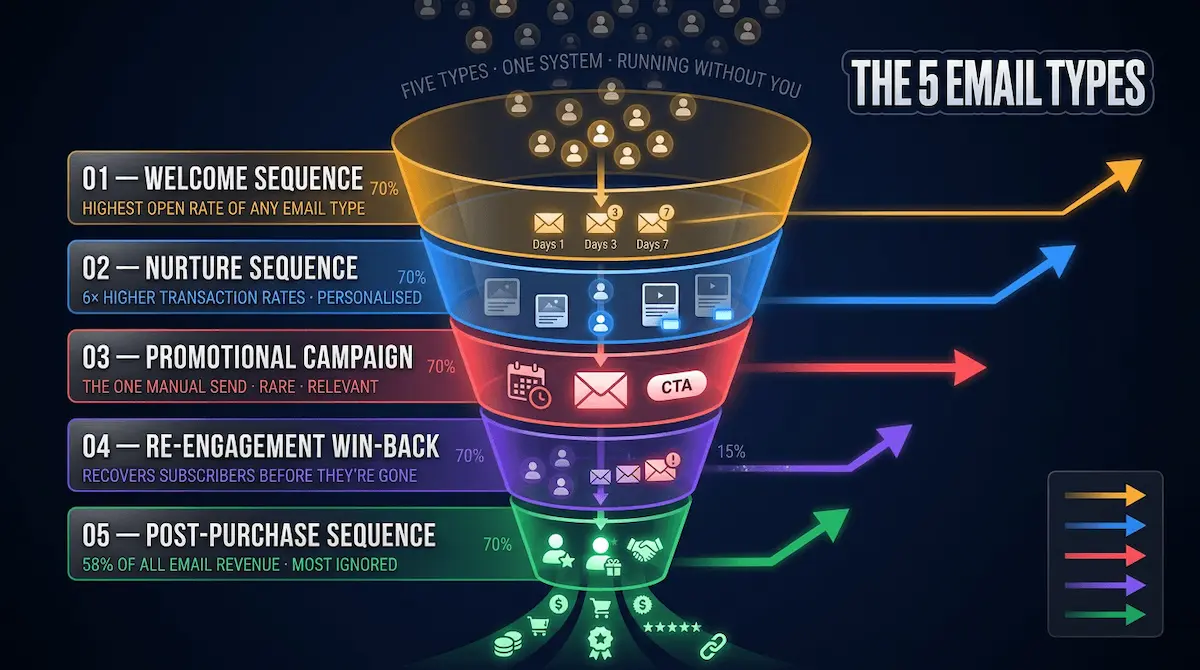
Here are the five email types that every small business needs. In that order.
The Welcome Sequence — Your Highest-Converting Automation
The welcome sequence is the most important email you will ever send — and most small businesses either skip it entirely or reduce it to a single generic "thanks for subscribing" message that does nothing. A proper welcome sequence runs three to five emails over seven to ten days. It introduces who you are, establishes what subscribers can expect, delivers on whatever promise brought them to your list in the first place, and makes a soft offer before the relationship goes cold.
Welcome emails achieve the highest open rates of any email type — because the subscriber just opted in and your name is still fresh. That window closes fast. A well-built welcome sequence captures that attention and converts it before it disappears.
The Nurture Sequence — How You Turn Subscribers Into Buyers
Most subscribers are not ready to buy when they first join your list. They need time, context, and repeated proof that you understand their problem and can solve it. The nurture sequence provides all three — automatically. A good nurture sequence runs eight to twelve emails over four to six weeks, alternating between value-driven content and soft conversion moments. Personalised emails deliver six times higher transaction rates Campaign Monitor — and a properly segmented nurture sequence is the most accessible form of personalisation available to a small business owner without an enterprise budget.
The Promotional Campaign — The One Manual Email Worth Sending
This is the only email type on this list that I recommend sending manually — because it should be tied to a specific moment, offer, or event that is genuinely time-sensitive. A product launch. A seasonal promotion. A limited availability offer. One to three emails, sent to a segmented list, with a single clear CTA. Keep it rare, keep it relevant, and your promotional emails will convert. Send them every week to everyone and they will be ignored.
The Re-Engagement Sequence — How to Win Back the People Going Cold
Every list has a segment of subscribers who opened everything for the first ninety days and then went quiet. Most business owners ignore them — which is a significant revenue leak. A three-email re-engagement sequence, triggered automatically when a subscriber has not engaged in sixty to ninety days, recovers a meaningful percentage of those contacts before they disengage permanently. The subject lines do the heavy lifting here — pattern interrupts, direct questions, and honest "should I remove you?" emails consistently outperform standard promotional copy with cold segments.
The Post-Purchase Sequence — The Revenue Stream Most Businesses Completely Ignore
Segmented and targeted emails generate 58% of all email revenue Campaign Monitor — and the post-purchase sequence is the most underused segmentation trigger available. A customer who just bought from you is at peak trust. They have made a decision. They have seen your product or service deliver. A three to five email post-purchase sequence — combining a thank you, a usage or onboarding guide, a review request, and a complementary offer — captures repeat revenue at the exact moment it is most likely to convert. I have seen this single sequence add fifteen to twenty percent to monthly revenue for service businesses that had never used it before.
⚡ Automate It
| Email Type | Trigger | Tool | Automate? |
|---|---|---|---|
| Welcome Sequence | New subscriber joins list | MailerLite / ConvertKit | ✅ Fully |
| Nurture Sequence | Welcome sequence completes | ConvertKit / ActiveCampaign | ✅ Fully |
| Promotional Campaign | Manual — time-specific event | Any ESP | ⚡ Partial |
| Re-Engagement Sequence | No engagement in 60–90 days | ActiveCampaign / MailerLite | ✅ Fully |
| Post-Purchase Sequence | Purchase or booking confirmed | ActiveCampaign / Klaviyo | ✅ Fully |
Four of the five email types on this list run entirely on autopilot once they are built and if you want to go deeper on how automation and email marketing work together as a unified strategy, our guide to email marketing marketing automation is the natural next read. The next section shows you exactly how to build each automated sequence — the precise structure, the trigger logic, and the goal each one is designed to achieve.
3) What to Automate — The 6 Sequences That Run Your Email Marketing Without You
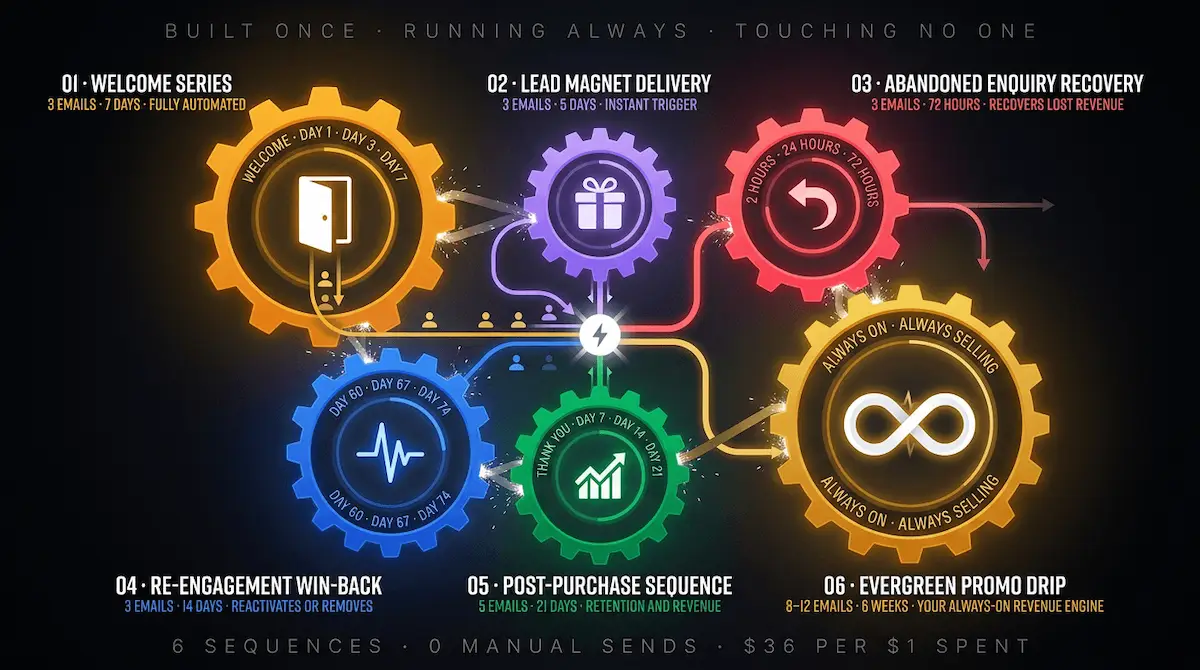
This is the section most email marketing guides never actually write. They tell you automation is important, list a few generic examples, and move on. I am going to do something different — give you the exact six sequences, what triggers each one, how long it runs, and what it is specifically designed to achieve. Build these six and your email marketing runs without you. Not metaphorically. Literally.
Sequence 1 — The Welcome Series (Days 1, 3, 7)
Three emails. Triggered the moment someone joins your list. Email one delivers whatever you promised — the lead magnet, the discount, the free resource — and introduces who you are in two paragraphs, not ten. Email two, sent on day three, goes deeper on the problem you solve and why you are the right person to solve it. Email three, sent on day seven, makes a soft offer. No pressure, no countdown timer, just a clear invitation. This sequence alone, built correctly, converts between fifteen and twenty-five percent of new subscribers into engaged buyers before they have had time to forget who you are.
Sequence 2 — The Lead Magnet Delivery and Follow-Up
Separate from the welcome series — this sequence is triggered specifically when someone downloads a lead magnet rather than subscribing directly. The delivery email goes out immediately and automatically. Two follow-up emails over the next five days check in on whether they used it, answer the most common question it raises, and transition the subscriber naturally into your welcome series. The handoff is seamless. The subscriber never feels transferred — they feel looked after.
Sequence 3 — The Abandoned Enquiry Recovery
If your business takes enquiries, bookings, or discovery calls, you are losing a significant percentage of potential clients who started the process and stopped. This three-email sequence — triggered when someone visits your booking or contact page but does not complete the action — recovers a meaningful share of that lost revenue. The first email goes out within two hours. The second within twenty-four. The third within seventy-two. Each one addresses a different objection. Combined with the broader automated sales and marketing approach, this sequence alone can recover ten to fifteen percent of otherwise lost enquiries.
Sequence 4 — The Re-Engagement Win-Back
Triggered automatically when a subscriber has not opened or clicked anything in sixty to ninety days. Three emails. Subject lines that break the pattern — direct, honest, and slightly unexpected. The final email in the sequence tells the subscriber you are going to remove them from the list if they do not re-engage. That email consistently generates the highest click rate of the three. People do not want to be removed from things, even things they have been ignoring.
Sequence 5 — The Post-Purchase Upsell and Review Request
Five emails triggered automatically after a confirmed purchase or completed booking. Thank you, onboarding or usage tips, a check-in at day seven, a review request at day fourteen, and a complementary offer at day twenty-one. This sequence runs entirely without you and generates repeat revenue, social proof, and referrals simultaneously — three outcomes from one automated chain.
Sequence 6 — The Evergreen Promotional Drip
This is the sequence most small business owners have never heard of and almost none have built. An evergreen drip is a series of eight to twelve promotional emails — spread over four to six weeks — that every new subscriber eventually enters after completing your nurture sequence. It promotes your core offer, your best content, and your most compelling social proof in a fixed rotation. Every subscriber sees it. You write it once. It runs forever. This is where the $36 ROI actually lives for most businesses — not in manual campaigns, but in this invisible, always-on revenue engine.
⚡ Automate It
| Sequence | Trigger | Length | Goal |
|---|---|---|---|
| Welcome Series | New subscriber | 3 emails / 7 days | Convert and introduce |
| Lead Magnet Follow-Up | Lead magnet download | 3 emails / 5 days | Deliver and transition |
| Abandoned Enquiry | Incomplete booking/contact | 3 emails / 72 hours | Recover lost revenue |
| Re-Engagement Win-Back | 60–90 days no engagement | 3 emails / 14 days | Re-activate or remove |
| Post-Purchase Drip | Purchase confirmed | 5 emails / 21 days | Retention and upsell |
| Evergreen Promo Drip | Nurture sequence complete | 8–12 emails / 6 weeks | Always-on revenue |
Six sequences. Built once. Running permanently. The businesses doing this are not working harder than the ones still sending manual campaigns — they are working smarter, and the gap between the two compounds every single month. Knowing what to automate is half the equation. The other half is knowing what you need to stop doing — because some of what you are currently doing is actively undermining everything else.
4) What to Stop Doing Immediately — The 7 Email Mistakes That Are Killing Your Results
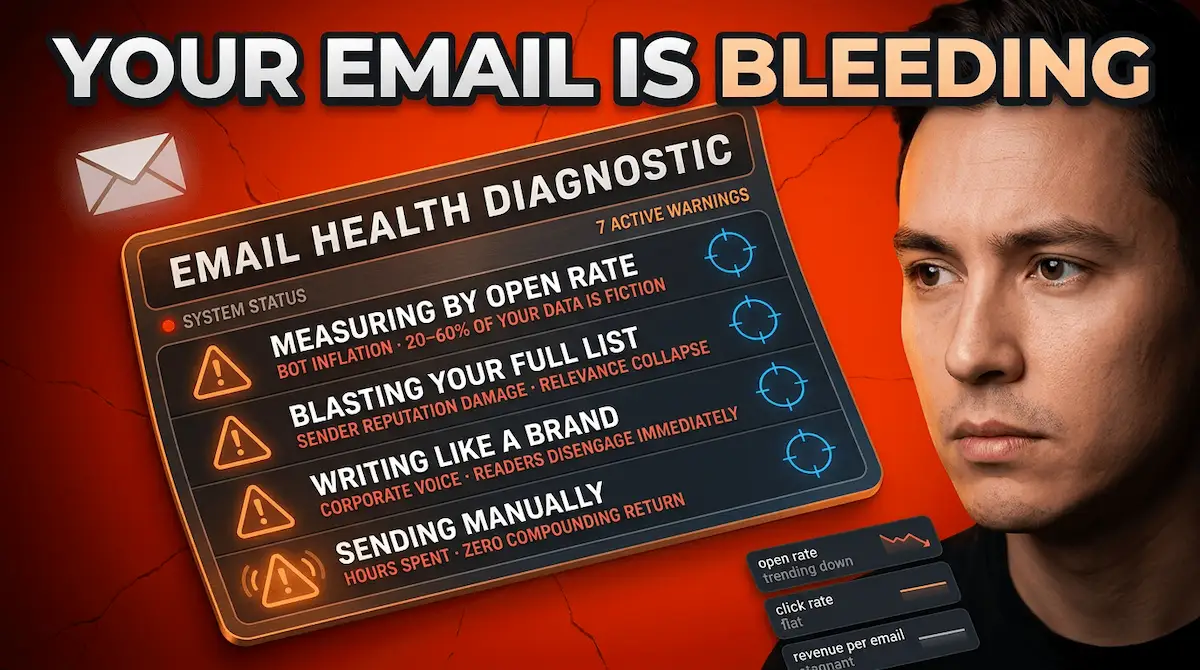
I am going to be direct here. Most of the email marketing advice circulating in small business communities is either outdated, platform-biased, or written by people who have never actually run a lean one-person operation. The result is that a lot of well-intentioned entrepreneurs are working against themselves without realising it. These are the seven mistakes I see most consistently — and every single one of them is fixable today.
Mistake 1 — Measuring Success by Open Rate
Open rates have been unreliable since Apple launched Mail Privacy Protection in 2021. Security filters and corporate firewalls increasingly pre-scan emails, clicking links automatically to test for malicious destinations — with estimates suggesting bot clicks now inflate between twenty and sixty percent of reported click metrics. Upland Adestra If your entire performance assessment is built on open rate, you are optimising for a number that does not reflect reality. Switch your focus to click rate, reply rate, conversion rate, and revenue per email. Those are the numbers that tell the truth.
Mistake 2 — Sending to Your Entire List Every Time
Your list is not one audience. It is dozens of micro-audiences at different stages of awareness, trust, and intent. Sending the same email to a brand new subscriber and a customer who bought from you three times is not just inefficient — it actively damages your sender reputation when the wrong people disengage. Segment by behaviour. At minimum, separate new subscribers, active engagers, and past customers. Three segments, three different messages, dramatically better results.
Mistake 3 — Writing Emails That Sound Like a Brand
The emails that get opened, read, and clicked are the ones that sound like they came from a person. Not a company. Not a marketing department. A person who knows the reader, understands their situation, and has something genuinely useful to say. The moment your email starts with "We are excited to announce" or "As a valued customer," you have already lost. Write in first person. Use short sentences. Have an opinion. Sound like yourself.
Mistake 4 — Sending Manually When You Should Be Automating
If you are still sitting down every week or fortnight to write and send a campaign to your entire list, you are spending time that your business cannot afford on a task that a properly built automation system handles permanently. The broader principles behind automation in marketing apply here with full force — every hour you spend on a manual task that could be automated is an hour that is not going toward growth. Build the sequences. Set the triggers. Step away.
Mistake 5 — Ignoring Mobile Optimisation
Mobile devices now account for more than half of all web traffic Shopify, and the majority of your subscribers are reading your emails on a phone. A single-column layout, large tap targets, short subject lines, and images that load quickly are not optional design choices — they are the baseline requirement for any email that wants to be read rather than deleted. If you have not opened one of your own emails on a phone recently, do it today. What you find will probably surprise you.
Mistake 6 — No Clear Single CTA Per Email
Every email needs one job. One link. One action you want the reader to take. The moment you include three different CTAs — read this post, check out this offer, follow us here — you create decision paralysis and the reader does none of them. Decide what each email is for before you write the first word. Then write everything in service of that one outcome. One email, one ask, one click.
Mistake 7 — Building on Rented Land Instead of Your Own List
I have watched entrepreneurs spend eighteen months building Instagram followings of ten, twenty, thirty thousand people — only to lose access overnight because of an algorithm change, an account flag, or a platform policy update they never saw coming. Your email list is the only marketing asset you actually own. No platform can take it from you. No algorithm can bury it. No policy update can make it disappear. Every hour you spend growing someone else's platform at the expense of growing your own list is a strategic mistake that compounds over time.
✅ Apply It
| Mistake | Why It Hurts | Fix Today |
|---|---|---|
| Measuring by open rate | Inflated by bots — not real engagement | Track clicks, replies, and revenue per email |
| Sending to full list | Kills sender reputation and relevance | Create three minimum segments today |
| Writing like a brand | Readers disengage from corporate voice | Rewrite your next email in first person |
| Sending manually | Consumes time with no compounding return | Build one automation sequence this week |
| No mobile optimisation | Over half your readers are on a phone | Test every email on mobile before sending |
| Multiple CTAs per email | Decision paralysis — reader clicks nothing | One email, one ask, one link |
| Building on rented land | Platform can disappear your audience overnight | Redirect every social effort to list growth |
Fixing these seven mistakes costs nothing and takes less time than you think. But fixing mistakes is only half the work — the other half is building the asset that makes all of it worthwhile. And that starts with a list worth having, which means understanding exactly how to grow one from zero without spending a single dollar on paid traffic.
5) How to Build an Email Marketing for Business List From Zero — Without Paid Ads
Every great email list started at zero. Every single one. The entrepreneurs I speak to who now have lists of five, ten, twenty thousand subscribers all started with the same number you have right now — and almost none of them paid for a single subscriber in the early stages. What they had was a clear offer, a smart placement strategy, and the patience to let organic growth compound. Here is exactly what that looks like in practice.
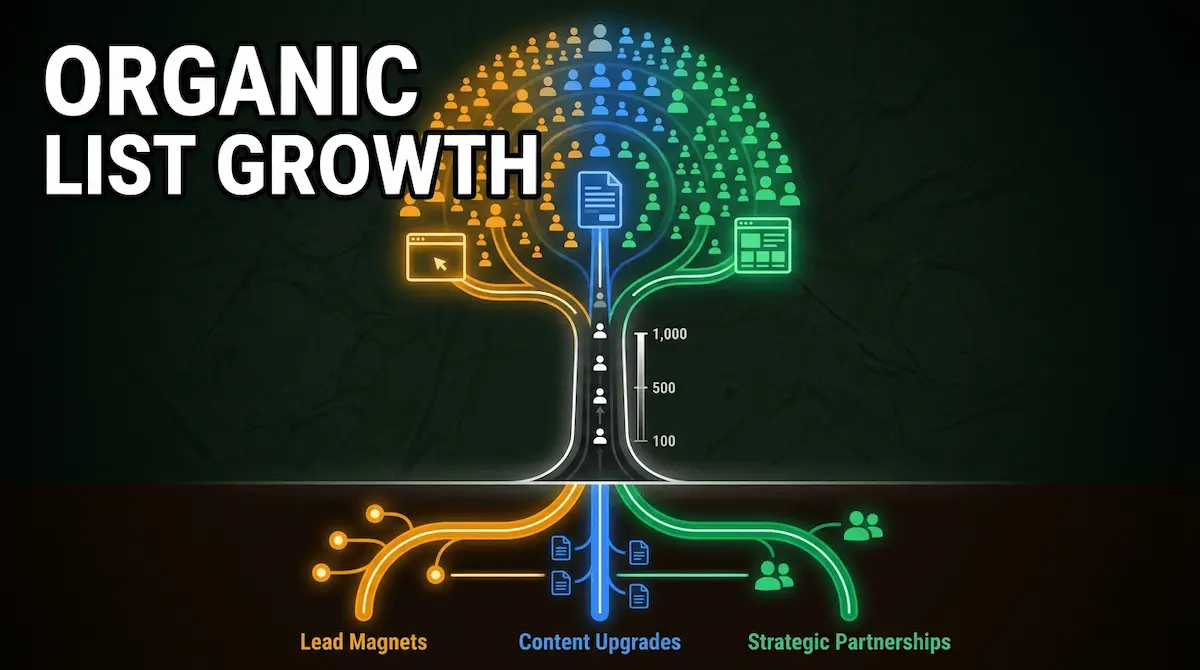
The Only Three List-Building Methods That Actually Work for Small Businesses
I have tested and observed a lot of list-building tactics over the years. Most of them are either too slow, too expensive, or too dependent on an audience you do not have yet. Three methods consistently outperform everything else for small business owners starting from zero.
The first is the lead magnet. A single, specific, immediately useful free resource — a checklist, a template, a short guide, a calculator — offered in exchange for an email address. Not a generic newsletter sign-up. A specific promise of specific value. Exit popups offering a lead magnet deliver between one hundred and one hundred and fifty-five percent conversion lift Campaign Monitor compared to standard opt-in forms — which means the same traffic produces dramatically more subscribers when the offer is right.
The second is the content upgrade. A piece of bonus content that extends a specific blog post or video — offered mid-content to readers who are already engaged enough to keep reading. Someone who opts in for a content upgrade is telling you exactly what problem they want solved. That intent signal makes them significantly more likely to convert downstream than a generic list subscriber.
The third is the strategic partnership opt-in. A cross-promotion with a complementary business whose audience overlaps with yours — a guest post, a joint webinar, a shared resource — that drives their audience directly to your opt-in page. This is the fastest way to add a meaningful number of highly qualified subscribers without a single dollar in ad spend. For a deeper look at how this fits into a broader growth system, our guide to email marketing small business covers the list-building piece in full detail.
The Lead Magnet Formula — What to Offer and How to Deliver It Automatically
The most common lead magnet mistake I see is trying to create something comprehensive. A forty-page ebook. A ten-module mini course. An exhaustive resource that takes three weeks to build and converts at a fraction of the rate of a one-page checklist. The formula is simple: identify the single most pressing question your ideal subscriber has right now, and answer it completely in the most concise format possible. That is your lead magnet. Delivery is fully automated — a trigger in your email platform sends it the moment someone opts in, with zero manual involvement from you. The automated marketing for small business playbook goes deeper on how to connect your lead magnet delivery to a full nurture system.
The Opt-In Placement Strategy — Where to Put Your Forms for Maximum Conversion
The placement of your opt-in form matters as much as the offer itself. Most small business owners put a single sign-up form in their website footer and wonder why their list grows slowly. The highest-converting placements are the exit intent popup — triggered when a visitor moves to leave the page — the mid-content inline form placed at the point of highest engagement in a blog post, and the dedicated landing page that exists for the sole purpose of capturing the opt-in. Three placements, one lead magnet, deployed consistently across your highest-traffic pages. That combination is what turns a trickle of subscribers into a steady, compounding flow.
✅ Apply It
| Method | Action | Tool | Time to implement |
|---|---|---|---|
| Lead Magnet | Create one specific, concise free resource | Canva + MailerLite | 2–4 hours |
| Content Upgrade | Add bonus content to your highest-traffic post | ConvertKit + Ghost | 1–2 hours |
| Strategic Partnership | Identify one complementary business for cross-promo | Email outreach | 1 hour to pitch |
| Exit Intent Popup | Install on highest-traffic pages | Sumo / OptinMonster | 30 minutes |
| Mid-Content Form | Place inline opt-in in top three blog posts | MailerLite embed | 20 minutes |
| Dedicated Landing Page | Build one page whose only job is the opt-in | MailerLite / ConvertKit | 1–2 hours |
List building is a system, not a campaign — and like every other system in this post, it compounds over time once the right pieces are in place. The final piece is knowing exactly which tools to use, what they cost, and the order in which to build everything — so you are not setting up the right things in the wrong sequence and wasting weeks of effort.
6) The Lean Email Stack — The Tools, the Cost, and the Setup Order That Gets You Running
Here is the conversation I wish someone had with me earlier in my business: you do not need an expensive platform, a complex tech stack, or a dedicated email marketing specialist to run a world-class email marketing system. You need three tools, a clear setup sequence, and about a weekend of focused work. Everything after that is optimisation. Here is exactly what that looks like.
The Three Tools You Actually Need — And the Ones You Can Ignore
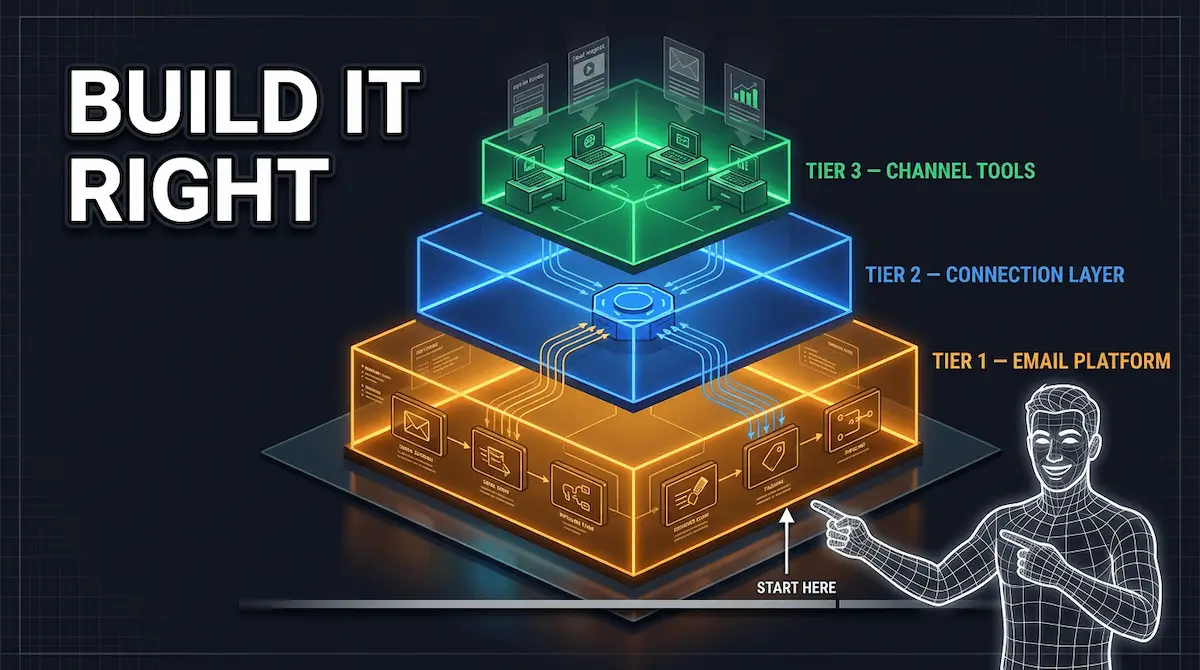
The email marketing tool landscape is deliberately confusing. Platforms spend significant budget making you feel like you need features you will not use for years — if ever. For a small business owner building a lean, automated email system from scratch, the decision comes down to three tiers based on where you are right now.
MailerLite is where most small businesses should start. Free up to one thousand subscribers, automation included, landing pages included, and genuinely intuitive enough to build your first welcome sequence in an afternoon. There is no reason to pay for anything else until your list crosses one thousand and your sequences are already working.
ConvertKit — now rebranded as Kit — is the natural next step for content-led businesses and solopreneurs who need more sophisticated tagging, segmentation, and visual automation builders. The subscriber-based pricing is transparent and the platform is built specifically for the kind of one-person business that Vault AI Pro serves.
ActiveCampaign is the tool you graduate to when your sequences are mature, your list is growing consistently, and you need CRM functionality, advanced behavioural triggers, and predictive sending built into the same platform. It is more powerful and more complex — but by the time you need it, you will be ready for it.
Ignore everything else until one of those three stops serving you. The rabbit hole of platform comparisons is one of the most effective ways to spend three weeks doing research instead of building the system that actually makes money. For the broader role that automation and AI play in a complete small business marketing stack, that guide covers the full picture beyond email.
What It Costs to Run a Complete Email Marketing System in 2026
💰 Stack Snapshot
| Tool | Best for | Monthly cost | Setup priority |
|---|---|---|---|
| MailerLite | Starting out — 0 to 1,000 subscribers | $0 | Week 1 — Day 1 |
| ConvertKit / Kit | Content creators, solopreneurs scaling | $0–$25 | When list hits 1,000 |
| ActiveCampaign | Advanced automation + CRM | $19–$49 | When sequences are mature |
| Sumo / OptinMonster | Exit intent popups + opt-in forms | $0–$9 | Week 1 alongside ESP |
| Canva | Lead magnet design | $0–$15 | Before launch |
| Zapier / Make | Connecting email to other tools | $0–$10 | Once sequences are live |
Total to start: $0 — free tier covers everything you need to launch your first three sequences. Total at scale: under $60/month for a complete, fully automated email marketing system.
The Setup Order That Prevents You From Building the Wrong Thing First
This is the detail that saves you weeks of wasted effort. Most entrepreneurs set up their email platform, spend days customising templates, then realise they have no opt-in form, no lead magnet, and nothing to actually bring subscribers into the system they just built. The correct order is the opposite of that.
Start with the lead magnet — the asset that gives someone a reason to join your list. Then build the opt-in form and landing page that delivers it. Then connect your email platform and build the welcome sequence that follows. Then add the nurture sequence. Then the re-engagement sequence. Then the post-purchase sequence. Then the evergreen drip.
In that order, every piece has a purpose before it is built and a clear trigger connecting it to the piece before it. Understanding how this fits into the wider discipline of automation business process design is what separates entrepreneurs who build systems that compound from those who build tools that sit idle. And if you want to see how the entire automation in marketing ecosystem connects email to every other channel in your business, that pillar guide is the complete picture.
The stack is lean. The cost is minimal. The setup order is clear. What takes time is the building — and that is exactly the part that Vault AI Pro has already done for you.
The Difference Between Knowing and Having
Here is the honest truth about everything covered in this post. The welcome sequence, the evergreen drip, the abandoned enquiry recovery, the re-engagement win-back, the post-purchase upsell, the lean stack, the setup order, the seven mistakes — none of it is complicated. You now understand all of it. Understanding, however, is not the same as having.
What Vault AI Pro Members Skip Entirely
Most entrepreneurs who read a guide like this one do one of two things. They bookmark it, intend to come back to it, and never build anything. Or they sit down to build it from scratch — writing welcome emails, drafting nurture sequences, designing lead magnets, mapping automation triggers — and spend the better part of two weeks producing something that may or may not work.
Vault AI Pro members do neither.
Every email sequence referenced in this post already exists inside the Vault — written, structured, and ready to deploy. The welcome series. The nurture drip. The re-engagement win-back. The post-purchase sequence. The evergreen promotional drip. The lead magnet delivery flow. Done. Not as inspiration or loose templates you still have to build from. As complete, copy-paste-ready resources you implement today and activate tomorrow.
One Decision. Your Email Marketing Running by the Weekend.
The $36 return is real. The autopilot system is real. The only question is whether you spend the next two weeks building it from scratch or the next two hours deploying what is already waiting for you.
10,000+ entrepreneurs have already made that decision. Here is yours.
Your Email Marketing System.
Ready to Deploy Today.
Inside Vault AI Pro you will find every email sequence, automation workflow, lead magnet template, nurture drip, re-engagement series, and post-purchase flow referenced in this post — written, structured, and ready to copy, paste, and activate. No team. No agency. No starting from scratch.
What is waiting for you inside:
✅ Welcome sequence — 3 emails, ready to activate
✅ Nurture drip — 8 emails, written and structured
✅ Re-engagement win-back — deploy in 20 minutes
✅ Post-purchase upsell sequence — complete and ready
✅ Evergreen promotional drip — your always-on revenue engine
✅ Lead magnet delivery flow — automated from opt-in to inbox
✅ 1,000+ additional AI prompts, templates and workflows
Join 10,000+ entrepreneurs saving 3–5 hours every single day
(that is 100+ hours back every month.)
Updated weekly. No tech skills needed. Cancel any time.