Email Marketing for Small Business in 2026: The 6-Part System That Runs While You Work on Everything Else
Most small businesses treat email marketing as something they will get serious about later. The ones growing consistently in 2026 built the system first — six parts, running automatically, generating revenue while they focused on everything else. This is exactly how they did it.

Here is the honest version of why email marketing for small business rarely works the way most owners expect it to.
It is not because they chose the wrong platform. It is not because their subject lines need work. It is not because they are doing it wrong.
It is because they are not doing it at all. They signed up for a tool, sent two newsletters, got busy, and quietly decided they would come back to it when things slowed down. Things never slowed down. The emails stopped. The list sat there. The channel they were closest to owning became one more thing they meant to get around to.
I understand exactly how that happens. 40% of small business owners say lack of time is the primary reason they delay or procrastinate on marketing tasks. Constant Contact That is not a discipline problem. That is a structural problem. When email marketing requires you to show up and push it manually every single time, it competes directly with everything else your business needs from you — and everything else usually wins.
This post is about fixing the structure, not the effort.
Email marketing for small business in 2026 is not about sending better newsletters. It is about building a six-part system that runs independently of how many fires you are putting out this week. 81% of small businesses rely on email as their primary customer acquisition channel and 80% use it for retention Oberlo — but the ones actually generating consistent revenue from it are not the ones who write the best emails. They are the ones who built the system once and let it run.
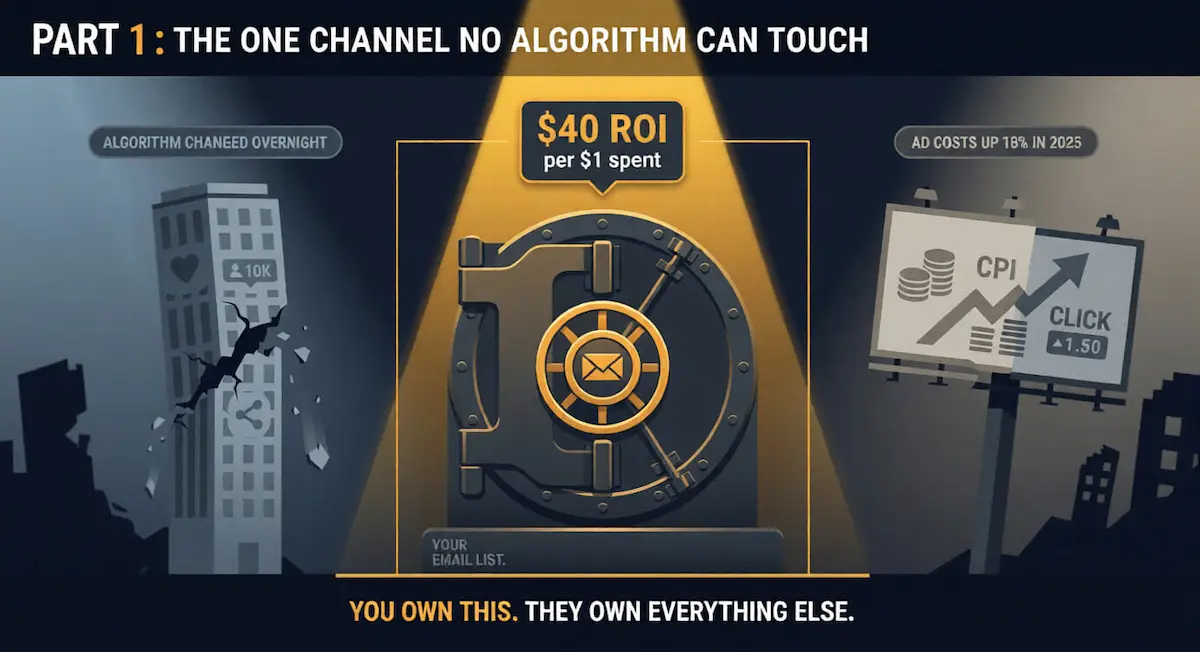
Email marketing generates $40 in return for every dollar spent — the highest ROI of any marketing channel available. PPC Chief That number does not belong to businesses with marketing teams. It belongs to businesses with a working system. And the system is what this post builds — six parts, in order, each one compounding on the one before it.
By the time you finish reading, you will have the exact framework. And if you want it already built, ready to deploy without starting from scratch, that is waiting for you too, inside Vault AI Pro.
1) Why Email Marketing Is Every Small Business's Most Powerful Owned Asset in 2026
Let me ask you something before we get into the system itself.
How many of your current marketing channels would survive if the platform running them changed its rules overnight?
Your Instagram following — gone if the algorithm deprioritises your content, or if the platform restricts business accounts, or if your niche simply stops performing. Your Facebook page — irrelevant the moment organic reach collapses further than it already has. Your TikTok presence — in genuine jeopardy depending on regulatory decisions that have nothing to do with your business or the quality of your content. I have watched small business owners pour two, three, four years of consistent effort into social platforms and wake up one morning to find their reach had been cut in half by an update they had no warning about and no recourse against.
This is the core problem with rented channels. You are building on someone else's land. And the landlord changes the lease whenever it suits them.
Email marketing for small business works differently — fundamentally, structurally differently. With email, if your message reaches the inbox, it is directly accessible. No algorithm decides who gets it, when, or how often. InboxAlly The subscriber on your list opted in deliberately. They gave you permission to land in the most personal digital space they have. And unlike a social media follower, that subscriber belongs to your list — not to a platform. You can export that list today, move it to a different tool tomorrow, and every contact comes with you. No platform can take that away.
The Owned Channel Advantage — Why It Matters More in 2026 Than It Ever Has
65% of marketers lost visibility after the latest Instagram algorithm update in 2025, forcing heavier reliance on paid ads — while social media ad costs increased by 18% in the same period. ADdictive Digital For a small business with a lean marketing budget, that trajectory is unsustainable. Every year that passes, the cost of renting attention on social platforms goes up. Every year that passes, the cost of owning a direct line to your customers through email stays roughly the same — because you built the list, and the list is yours.
This is not an argument against social media. Social platforms are genuinely useful for visibility, for discovery, for putting your brand in front of people who have never heard of you. But there is a critical distinction between building an audience and owning one. Social media builds you an audience. Email marketing gives you an audience you own. The smartest small businesses I see in 2026 use social media to capture attention and email to convert it — the two channels working together, with email as the foundation neither of them can afford to lose.
The ROI Case — Laid Out Simply
Email generates between $36 and $40 for every dollar spent, compared to an average ROI of $2 to $5 for social media ads. InboxAlly That gap is not marginal. It is structural. Email converts at those rates because the recipient chose to be on your list. They raised their hand. They said yes. Every email you send arrives in an environment of pre-existing permission — and permission is the most valuable thing in marketing.
64.1% of small businesses say email is the channel they use most for their marketing campaigns, and 71.8% use it to communicate directly with their customers. Brevo The businesses quietly generating consistent revenue in 2026 are not the ones with the largest social following. They are the ones who understood, early, that the list was the asset — and built everything else around protecting and growing it.
If you want a deeper look at how email marketing for business fits into a broader growth strategy, that post covers the full commercial case. But for now, Part 2 of this system is where everything starts — because none of what follows works without a list worth sending to.
2) How to Build an Email List Your Small Business Actually Owns
Every conversation about email marketing eventually arrives at the same place: the list.
Not the platform. Not the sequences. Not the subject lines. The list. Because none of the system that follows — the automations, the nurture tracks, the revenue workflows — has anything to run on without a list of real people who chose to hear from you.
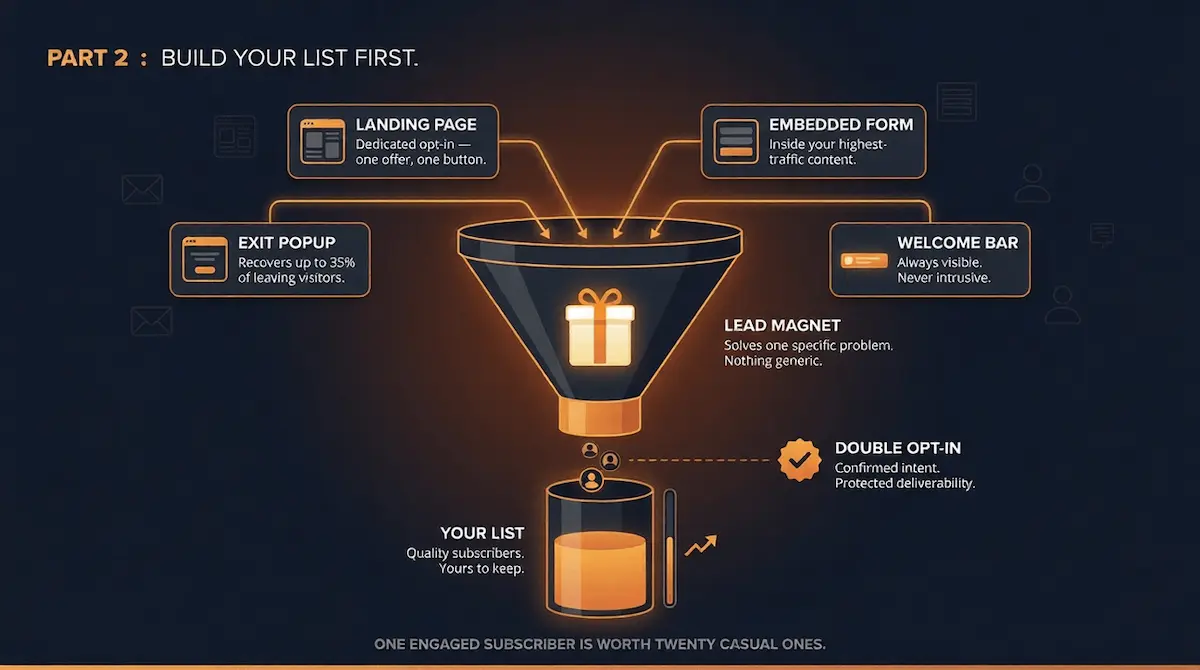
I want to make a distinction here that most list-building guides skip entirely. There is a difference between a big list and a valuable list. A big list is a vanity metric. A valuable list is a business asset. The difference is not size — it is quality of consent. A subscriber who joined your list because you offered them something genuinely useful, something that solved a real problem they had the moment they found you, is worth twenty times a subscriber who clicked a generic "subscribe to our newsletter" button out of mild curiosity and forgot about it within the hour.
Generic "subscribe to our newsletter" buttons no longer suffice in 2026. A good lead magnet must solve a real problem or fulfil a genuine desire Omnisend — and when it does, the subscriber who downloads it arrives already pre-sold on your expertise. That is not a contact. That is a warm lead with a name and an email address, sitting in your system, waiting for the first email to confirm they made the right decision.
The Lead Magnet — Your Single Most Important List-Building Asset
A lead magnet is the thing you offer in exchange for an email address. It can be a checklist, a template, a short guide, a free mini-course, a discount, a calculator, a swipe file, or a resource kit. The format matters less than the specificity. The best lead magnets I have seen from small businesses are not the longest or the most beautifully designed. They are the ones that answer one exact question the target customer is actively asking right now.
A florist offering "The 7 Flowers That Last Longest in a Vase — and How to Arrange Them in Under 10 Minutes" will outperform "Join our newsletter for floral tips" every single time. The first offer is specific, immediately useful, and tells the subscriber exactly what they are getting. The second offer asks someone to trust a vague promise they have heard from every other business on the internet.
Adding a targeted content upgrade to a single blog post took one business from a 0.37% opt-in rate to a 4.14% opt-in rate Encharge — an eleven-fold improvement with no change to the traffic, no change to the platform, just a more specific offer matched to what the reader was already looking for. That is the lead magnet principle in one number.
Where to Put Your Opt-In — The Four Placements That Actually Convert
Once you have a lead magnet worth offering, the question is placement. Most small businesses put their opt-in form in one place — usually the website footer, where it collects almost nothing. The businesses building lists consistently in 2026 treat opt-in placement as a deliberate decision tied to subscriber intent, not an afterthought.
The four placements that drive the most signups are: a dedicated landing page you can send traffic to directly from social media and partnerships; an embedded form inside your highest-traffic blog post or webpage matched contextually to what the reader is already consuming; an exit-intent popup triggered when a visitor is about to leave, capturing attention at the last viable moment; and a welcome bar or ribbon at the top of your homepage — low friction, always visible, never intrusive.
None of these require a developer. Every major email platform in 2026 builds these natively.
✅ EMAIL LIST BUILDING — THE SMALL BUSINESS STARTER FRAMEWORK
| Step | What to Do | Why It Matters | Time to Build |
|---|---|---|---|
| 1 | Create one specific lead magnet that solves one exact problem | Quality of consent determines list value — not size | 2–3 hours |
| 2 | Build a dedicated landing page — one offer, one button, nothing else | Removes all distraction — visitor either subscribes or leaves | 1 hour |
| 3 | Embed an opt-in form inside your highest-traffic page or post | Captures subscribers already engaged with your content | 30 minutes |
| 4 | Add an exit-intent popup on your homepage and key pages | Recovers up to 35% of visitors who would otherwise leave without subscribing | 30 minutes |
| 5 | Use double opt-in to confirm every subscriber's intent | Protects deliverability and ensures only genuinely interested contacts enter your system | Platform setting — 5 minutes |
One thing I always tell small business owners who are anxious about starting with a small list: a hundred engaged subscribers who genuinely want to hear from you will generate more revenue than a thousand people who barely remember signing up. Start specific. Grow deliberately. The list you build with intention is the one that actually converts when the automations in Part 4 start running against it.
With the foundation in place, Part 3 covers what you actually send — because not all emails do the same job, and most small businesses are sending the wrong type for what they are trying to achieve.
3) The Email Types That Drive Real Revenue for Small Businesses — and the Ones That Just Fill Inboxes
The single most common mistake I see small businesses make with email marketing is treating every email as the same thing. They have a list, they have a platform, and they send. A product announcement one week. A newsletter the next. A promotional offer the week after. No logic connecting them. No system behind them. Just content going out because content needs to go out.
That approach is not email marketing. It is broadcasting. And broadcasting is the slowest, most exhausting way to generate revenue from an email list — because it requires you to manufacture something new every single time, and it never compounds.
The businesses generating consistent revenue from their lists in 2026 understand something fundamental: different email types do different jobs. And if you send the wrong type of email for the job you are trying to do, you will get the wrong result — not because your writing is bad, but because the format was wrong for the outcome you were chasing.
There are three categories of email every small business needs to understand, and only one of them will ever become the engine of your revenue.
Category One — Broadcast Emails (Your Relationship Layer)
Broadcast emails are the ones you schedule and send to your whole list at a set time. Newsletters, product announcements, promotional campaigns, seasonal offers, content roundups. These are the emails most small businesses default to because they feel tangible — you write them, you send them, you can see exactly what went out and when.
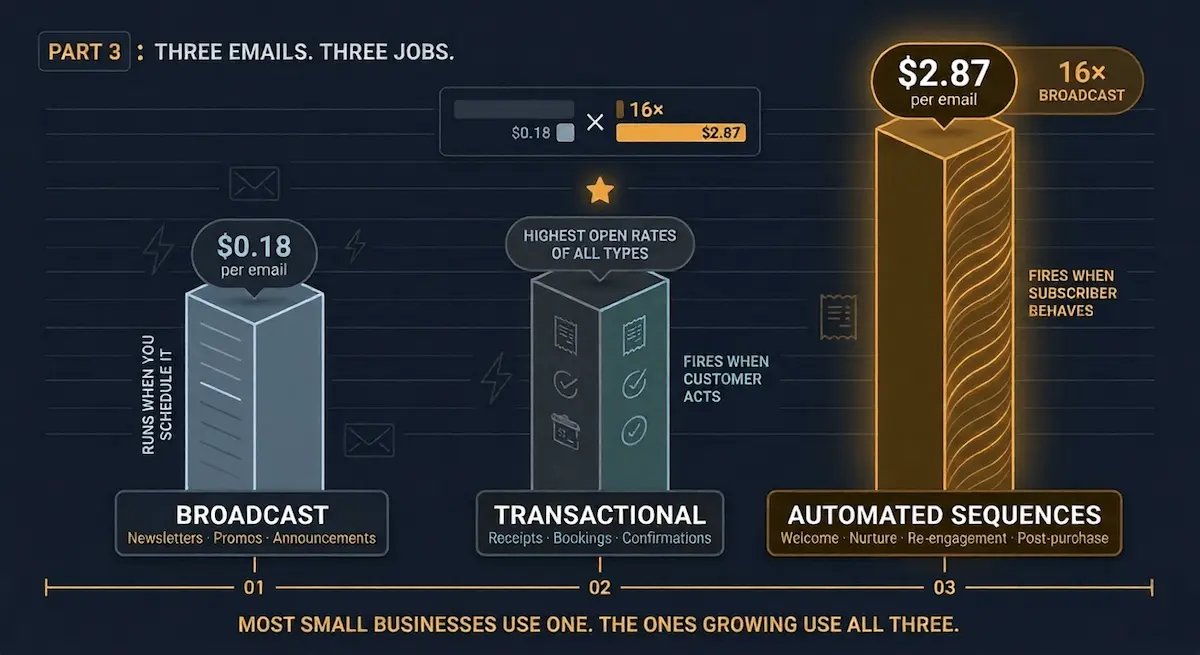
50% of small business owners say promotional emails are the most important campaign type they deliver to subscribers. Moosend I understand why. Promos are visible. Promos feel like marketing. But here is what the data actually shows: scheduled campaign emails generate on average $0.18 per email, while automated flows generate $2.87 per email — sixteen times more revenue per send from a fraction of the total volume. Omnisend
Broadcast emails are not useless. They maintain your relationship with the list between automations. They keep you top of mind. They drive traffic to new offers and content. But they are the relationship layer, not the revenue engine. The mistake is building an entire email strategy around them and wondering why the returns feel inconsistent.
Category Two — Transactional Emails (Your Trust Layer)
Transactional emails are the ones triggered by a customer action — order confirmations, delivery updates, booking confirmations, receipt emails, password resets. Most small businesses think of these as administrative rather than marketing. That is a missed opportunity.
Triggered emails average a 5.02% click-through rate, significantly outperforming newsletters at 3.84% WebToffee — because the subscriber is in an active state when they receive them. They just completed a transaction. Their attention is fully on your brand. A well-constructed order confirmation that includes a relevant next offer, a referral prompt, or a content link converts at rates that most promotional emails never approach. The transaction email is the most read email you will ever send. Treating it as a receipt is leaving money on the table.
Category Three — Automated Sequence Emails (Your Revenue Engine)
This is where the compounding happens. Automated sequence emails are triggered by subscriber behaviour — joining your list, clicking a specific link, visiting a pricing page, going quiet for sixty days, completing a purchase. They fire automatically, in response to what a subscriber does, without you scheduling or writing anything new.
Automated email sequences convert leads 47% better than single emails Entrepreneurs HQ, and that gap compounds over time. Every new subscriber who joins your list enters your welcome sequence automatically. Every subscriber who clicks your pricing page link enters your high-intent nurture track automatically. Every subscriber who goes cold enters your re-engagement sequence automatically. The system runs regardless of how busy your week is — and this is precisely why automation in email marketing is the part of this system most small businesses invest in last but benefit from first.
🎯 THE THREE EMAIL TYPES — WHAT EACH ONE DOES FOR YOUR SMALL BUSINESS
| Email Type | Examples | Job | Revenue per Email | Runs When |
|---|---|---|---|---|
| Broadcast | Newsletter, promo, announcement | Maintain relationship, drive traffic | ~$0.18 | You schedule it |
| Transactional | Order confirmation, receipt, booking | Build trust, create upsell opportunities | Highest open rates of all types | Customer completes action |
| Automated Sequence | Welcome, nurture, re-engagement, post-purchase | Convert, retain, recover revenue | ~$2.87 — 16× broadcast | Subscriber behaviour triggers it |
The practical takeaway is simple. Use broadcast emails to stay visible and maintain the relationship. Optimise your transactional emails to capture the high-attention moments after a customer action. And build your automated sequences to do the revenue work — because they are the only email type that generates consistent income without requiring you to generate consistent effort.
Part 4 is entirely focused on those automated sequences — the specific workflows every small business needs running, in the exact order they should be built.
4) Why Email Marketing Automation Is the Smartest Move a Small Business Can Make in 2026
I want to tell you about a conversation I had with a small business owner who runs a personalised gift company out of her spare room. She had about 800 subscribers, a MailerLite account she barely touched, and a newsletter she sent when she remembered to — which was roughly every six weeks. She told me email marketing was not working for her.
When I looked at her account, she had no welcome sequence. She had no post-purchase follow-up. Nothing fired when someone joined her list at 2am on a Sunday because they had just found her on Pinterest. The subscriber arrived, received silence, and either forgot about her or found someone else. The emails were not failing. The automation was simply absent.
I helped her set up a three-email welcome sequence over one afternoon. Four weeks later she messaged to say two subscribers had bought directly from email three of the sequence — the one with the product recommendation — without her doing anything after the initial setup. That is not a miracle. That is what automation does when it is finally turned on.
Why Automation Transforms Email Marketing for Small Businesses Specifically
Large businesses have marketing teams. They can send manually, follow up individually, and segment their list by hand if they want to. Small businesses cannot. The one resource a small business owner consistently does not have is time — and manual email marketing eats time voraciously, every single week, without compounding.
Automation solves this at the structural level. Automated email sequences generate 320% more revenue than non-automated emails while simultaneously reducing operational costs by 30% Landbase — because they eliminate the manual tasks that consume the hours a small business owner never had. The sequence runs while you are making product, serving clients, doing payroll, or simply not working. It does not care what day it is. It does not need a reminder.
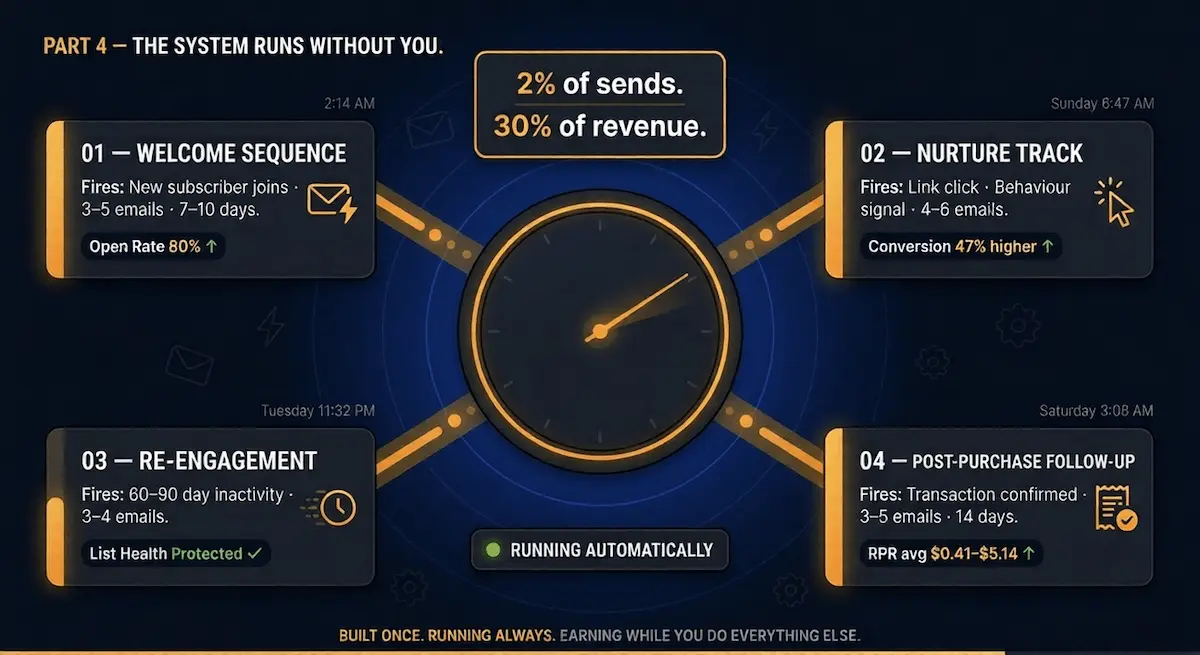
Automated emails account for just 2% of total email sends but drive 30% of total revenue — earning sixteen times more per send than scheduled campaigns. Omnisend That ratio is not an anomaly from a large brand with a sophisticated stack. It is the structural reality of what happens when you replace scheduled guessing with behaviour-triggered relevance. The right email, to the right person, at the exact moment they are most likely to act on it.
The Four Workflows Every Small Business Needs Running First
Not every automation workflow carries equal weight. I always tell small business owners to build in this specific order — because each workflow feeds the next, and starting anywhere else means building on an incomplete foundation.
Workflow 1 — The Welcome Sequence. This fires the moment someone joins your list. It is the highest-leverage automation in your entire system. Automated welcome emails achieve an average open rate of 80% with a 26% click-through rate Mailmodo — because the subscriber is at peak curiosity about you in the first 48 hours. A three-email welcome sequence — immediate delivery of what you promised, your story and what makes you different, and a specific next-step offer — turns a new contact into a warm lead before you have done a single thing manually.
Workflow 2 — The Nurture Track. This fires when a subscriber signals interest in something specific — clicking a product link, visiting your services page, downloading a specific resource. The signal tells you what they want. The nurture track responds to that signal with content and offers directly relevant to it. This is where email marketing marketing automation begins earning its keep — behaviour triggers converting intent into revenue without a manual decision in the chain.
Workflow 3 — The Re-Engagement Sequence. Every list goes cold over time. Subscribers who have not opened or clicked in 60 to 90 days need a specific sequence — three to four emails designed either to win them back with a direct offer or exit them cleanly from the list. This is not just a revenue workflow. It is a deliverability protection workflow. A list full of disengaged subscribers quietly destroys the performance of every other sequence you run.
Workflow 4 — The Post-Purchase Follow-Up. This fires after any transaction — a purchase, a booking, a completed consultation. Post-purchase sequences generate an average revenue per recipient of $0.41 with top performers reaching $5.14 Brevo — because a customer who just bought from you is the warmest lead you have. A well-timed post-purchase sequence that delivers value, asks for a review, and introduces the next relevant offer compounds customer lifetime value without any additional acquisition cost.
⚡ THE FOUR AUTOMATION WORKFLOWS — BUILD IN THIS ORDER
| Workflow | Trigger | Length | Primary Job | Build First? |
|---|---|---|---|---|
| Welcome Sequence | New subscriber joins list | 3–5 emails / 7–10 days | Convert interest into a warm lead | ✅ Yes — always first |
| Nurture Track | Link click / page visit / tag applied | 4–6 emails / 14 days | Convert intent signals into sales | ✅ Build second |
| Re-Engagement | 60–90 days no open or click | 3–4 emails / 10 days | Win back or remove cleanly | ✅ Build third |
| Post-Purchase | Transaction confirmed | 3–5 emails / 14 days | Retain, upsell, generate referrals | ✅ Build fourth |
The deeper guide on building and connecting these workflows sits inside our automation in marketing pillar — it covers the full system architecture in detail. For now, the most important thing to understand is this: these four workflows, running simultaneously, mean that every subscriber who enters your list moves through a logical automated journey based on what they do — not what you happened to have time to send that week.
That is the 6-part system starting to work as a system. Part 5 covers the platform decision — because the automation you just mapped out needs a home, and not every platform builds these workflows equally.
5) How to Choose the Right Email Marketing Platform for Your Small Business
The platform question is where I watch small business owners lose the most time before they have sent a single email.
They spend three weeks reading comparison articles, signing up for four free trials simultaneously, watching YouTube tutorials on tools they will never use, and eventually picking either the most recognisable name they have heard of or the cheapest option they can find. Neither decision is made on the right basis — and both regularly end in a platform switch six months later that costs more time than the original research.
Here is the filter I use, and the only one that matters for a small business getting this system live: does this platform support all four workflows from Part 4 without requiring a developer, a Zapier connection, or a paid upgrade just to access basic automation?
That is the question. Everything else — the template library, the AI subject line generator, the design awards — is secondary to whether the tool can build and run a welcome sequence, a nurture track, a re-engagement flow, and a post-purchase follow-up in a single interface without breaking your budget or your patience.
If You Are Starting Out — Under 1,000 Subscribers
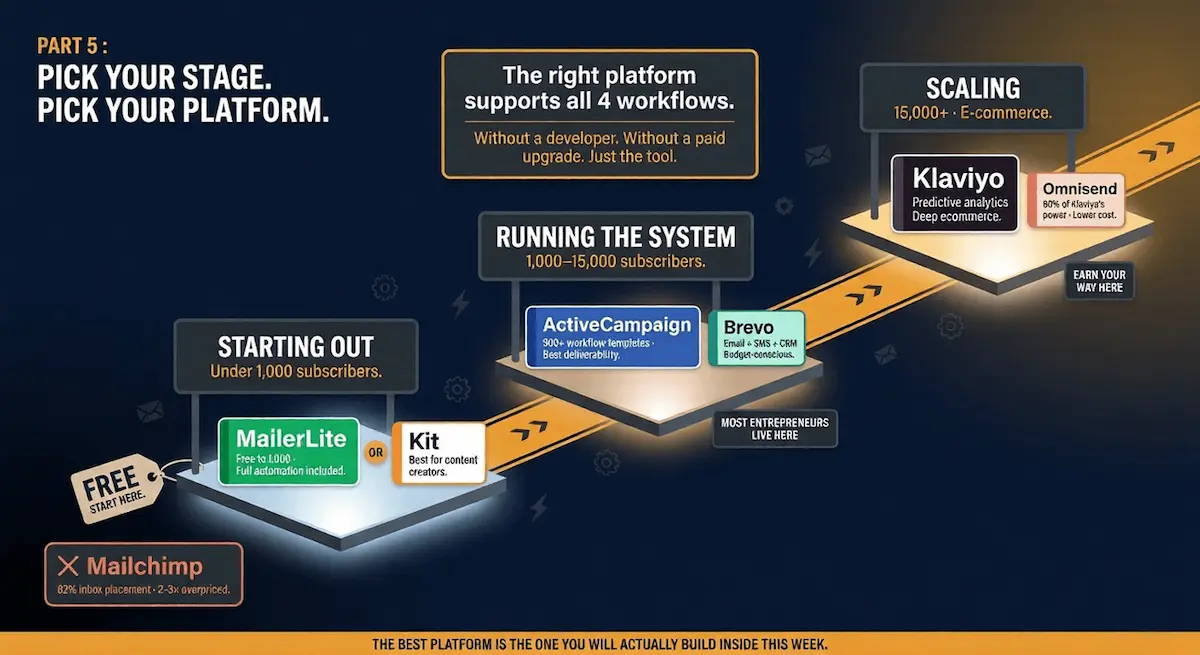
MailerLite is purpose-built to have everything small businesses, solopreneurs, and creators need to implement effective marketing campaigns MailerLite — and it does this at a price point that removes every excuse for not starting. The free plan covers up to 1,000 subscribers with full automation access included. The visual workflow builder is clean and genuinely intuitive. You can have your welcome sequence live within an hour of opening the account.
The honest limitation: MailerLite excels in simplicity but lacks some of the advanced automation capabilities found in more sophisticated platforms. Campaign Monitor If your ambition is multi-conditional branching logic, lead scoring, and deep CRM integration from day one, MailerLite will eventually feel restrictive. But if you are under 1,000 subscribers and your goal is getting the four core workflows from Part 4 running this week — MailerLite is the right tool. Do not let platform envy slow you down before you have something worth optimising.
Kit (formerly ConvertKit) is the alternative here if your business model is content-led — newsletters, digital products, courses, or memberships. The subscriber tagging system is exceptionally clean, and the upgrade path to paid tiers is transparent and predictable. For pure content creators, Kit's architecture fits the business model more naturally than MailerLite's.
If You Are Running the System — 1,000 to 15,000 Subscribers
This is where the platform decision becomes genuinely consequential. You have sequences running. You have subscribers moving through them. You need conditional logic, behavioural segmentation, and the intelligence layer that connects your broadcasts to your automations — and not every platform at this tier handles it equally.
ActiveCampaign is the standout all-round performer at this stage — pairing email marketing with CRM features and over 900 customisable automation workflow templates that cover almost every part of the customer journey. Brevo The learning curve is real. Plan two to four weeks before the platform feels fully natural. But the capability ceiling is high enough that the vast majority of small businesses will never hit it. In independent 90-day testing, ActiveCampaign achieved a 93% inbox placement rate — the highest of any platform tested. La Growth Machine Deliverability at that level quietly compounds revenue over time in ways that are almost impossible to attribute but absolutely real.
Brevo is the strong alternative here for businesses that want email, SMS, and a basic CRM in a single tool without the ActiveCampaign price tag. At 1,000 contacts, Brevo sits at $25 per month versus ActiveCampaign at $49 La Growth Machine — and for businesses where budget is a genuine constraint, that gap matters. Brevo's automation builder is less powerful than ActiveCampaign's but more than sufficient for running the four core workflows cleanly.
If You Are Scaling — E-commerce or 15,000+ Subscribers
One platform pulls decisively ahead once email becomes a significant revenue driver for an e-commerce business. Klaviyo's deep store integrations, predictive analytics, and abandoned cart logic are in a different category from everything else at this stage. The pricing reflects it — Klaviyo becomes expensive quickly as your list grows — and I would not recommend it until email demonstrably drives at least 15% of your monthly revenue. Below that threshold, Omnisend or ActiveCampaign deliver comparable results at a fraction of the cost.
The one platform I consistently steer small businesses away from regardless of stage: Mailchimp. Independent testing found Mailchimp's inbox placement rate at 82% — below every meaningful competitor — while pricing sits at two to three times the cost of equivalent platforms. La Growth Machine Brand recognition is not a substitute for deliverability or value.
💰 EMAIL MARKETING PLATFORM — SMALL BUSINESS DECISION GUIDE 2026
| Stage | Subscribers | Best Pick | Alternative | Entry Price |
|---|---|---|---|---|
| Starting Out | Under 1,000 | MailerLite | Kit | Free |
| Running the System | 1,000–15,000 | ActiveCampaign | Brevo | $25–$49/mo |
| Scaling | 15,000+ / E-com | Klaviyo | Omnisend | Scales with list |
| Avoid at Every Stage | All sizes | Mailchimp | — | Overpriced for what it delivers |
One final thing worth saying plainly: the best platform for your small business email marketing system is the one you will actually open and build inside this week. A perfect platform with no workflows running earns nothing. An adequate platform with all four sequences live generates revenue every single day. Pick your stage. Make the decision. Get the system running. The metrics to tell you whether it is working come next in Part 6.
6) The Metrics That Tell You Whether Your Small Business Email Marketing System Is Working
Most small businesses check the wrong number first.
They open their email platform on a Monday morning, see a 38% open rate on Friday's newsletter, feel broadly reassured, and move on. Or they see 24% and feel vaguely anxious. Either way, they have learned almost nothing useful about whether their email system is actually working — because open rate is the least reliable metric in their dashboard, and it has been since Apple's Mail Privacy Protection began automatically pre-loading email content in 2021, inflating reported opens for anyone using Apple Mail.
Apple Mail accounts for approximately 46% of email clients — meaning a significant portion of every open rate you see is technically a phantom, registered by Apple's servers before a human ever laid eyes on your email. HubSpot
I am not saying open rates are useless. They still tell you something directional about subject line performance and sender reputation. But I have watched small business owners spend weeks obsessing over open rate when their click rate, their revenue per recipient, and their list growth rate were the numbers that would actually tell them what to fix. This section is about knowing which four numbers matter, what each one is telling you, and what to do when one of them drops.
Metric 1 — Click-to-Open Rate (Your Content Quality Signal)
Click-to-open rate — CTOR — measures the percentage of people who opened your email and then clicked something inside it. Unlike raw click rate, which is diluted by everyone who received the email, CTOR isolates the people who saw your content and tells you how compelling it was.
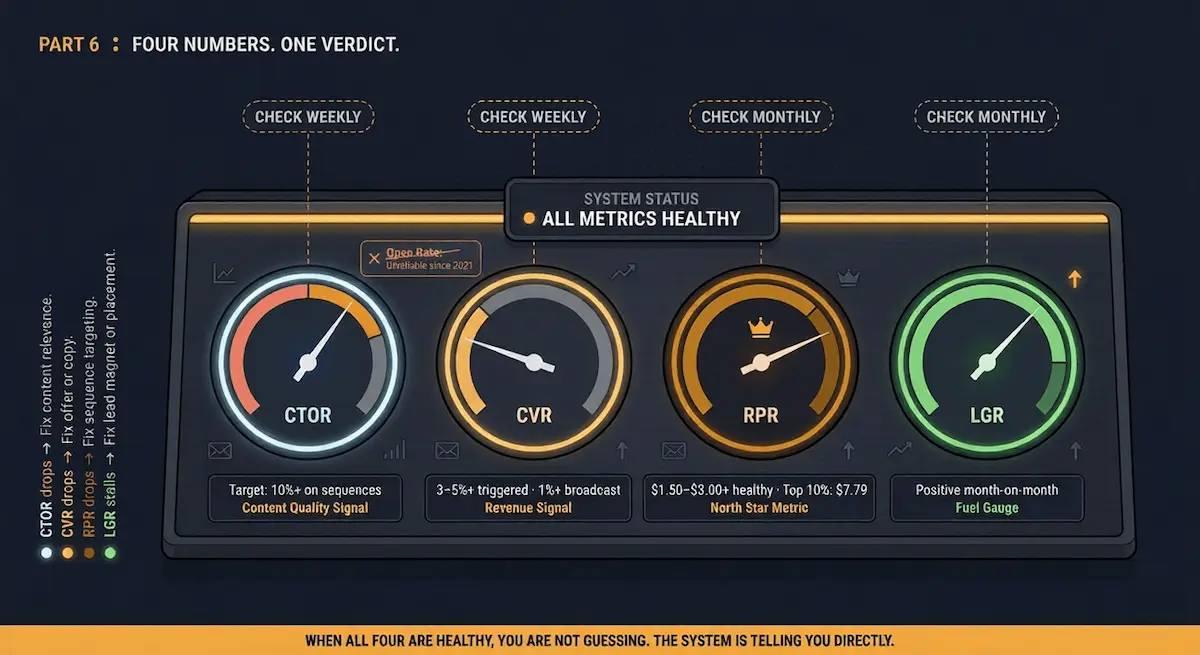
The average CTOR across all industries in 2025 was 6.81%, up from 5.63% the year before. MailerLite For automated sequences, I expect to see CTOR consistently above 10% — because a behaviour-triggered email arriving at the right moment for the right person should outperform a generic broadcast by a meaningful margin. If your welcome sequence CTOR is sitting at 4%, the problem is not your subject line. The content of the email is not matching what the subscriber expected when they signed up.
The fix is always the same: go back to what you promised at the point of opt-in and close the gap between that promise and what your email actually delivers.
Metric 2 — Conversion Rate (Your Revenue Signal)
This is the number that connects your email marketing system directly to your bank account. Conversion rate measures the percentage of email recipients who took the specific action you wanted — made a purchase, booked a call, downloaded the resource, started a trial.
The 2025 benchmark for conversion rate sits at 1% or above for newsletters, 3–5% for triggered emails, and up to 15% for highly targeted campaigns like abandoned cart flows. Bloomreach The gap between those three tiers is not accidental. It maps exactly to the three email types from Part 3 — broadcast, transactional, and automated sequence. The more precisely you match the email to the subscriber's current intent, the higher the conversion rate climbs.
If your broadcast campaigns are converting below 1%, the issue is usually offer timing or relevance — you are promoting something the subscriber is not ready for yet. If your triggered sequences are converting below 3%, the sequence is reaching the right people but the offer or the copy inside it is not doing its job.
Metric 3 — Revenue Per Recipient (Your System's North Star)
Revenue per recipient — RPR — is the single metric that tells you whether your overall email system is generating a return worth the investment. It divides your total email-attributable revenue by the total number of emails sent and gives you a clean per-email number to optimise against over time.
For a small business with a working system, a healthy RPR on automated flows sits between $1.50 and $3.00. Top 10% performers reach RPR as high as $7.79, driven by sophisticated segmentation and well-timed behavioural triggers. Klaviyo If your RPR across all emails is below $0.50, one of three things is happening: your offer is wrong, your targeting is off, or your sequences are not connected to your list-building properly — meaning the wrong subscribers are entering the wrong flows.
This is exactly why automation and ai is increasingly being used by small businesses to optimise RPR — the combination of behavioural triggers, predictive send times, and personalised content compounds the per-email return in ways that manual optimisation cannot match at scale.
Metric 4 — List Growth Rate (Your System's Fuel Gauge)
A perfectly optimised email system running against a shrinking list is a car with a slow puncture. Every list loses subscribers over time — people change email addresses, go cold, unsubscribe, or simply disengage. The average unsubscribe rate across all industries in 2025 was 0.22% MailerLite — which sounds small but compounds quickly against a static list.
List growth rate measures how fast new subscribers are joining relative to how fast others are leaving. A healthy small business list should be growing month on month, even modestly. If your growth rate is flat or negative despite consistent traffic to your site, the problem is almost always at the opt-in layer — either the lead magnet is not compelling enough, the form placement is wrong, or both.
✅ SMALL BUSINESS EMAIL MARKETING — 4-METRIC HEALTH CHECK
| Metric | Healthy Range | Warning Sign | What It Tells You | Check When |
|---|---|---|---|---|
| Click-to-Open Rate | 10%+ (sequences) · 6%+ (broadcasts) | Below 5% | Content quality + relevance signal | Weekly |
| Conversion Rate | 3–5%+ (triggered) · 1%+ (broadcast) | Below 1% across all types | Offer timing + copy effectiveness | Weekly |
| Revenue Per Recipient | $1.50–$3.00+ (flows) | Below $0.50 | Overall system health — north star | Monthly |
| List Growth Rate | Positive month-on-month | Flat or declining | Lead magnet + opt-in effectiveness | Monthly |
The discipline here is not sophisticated. Check CTOR and conversion rate weekly on any active sequence. Check RPR and list growth rate monthly and compare them against the previous month — not against industry averages, which vary too much by niche to be genuinely useful as a target.
When one metric dips, it points you directly to one part of the system. CTOR drops — your content or your audience targeting needs work. Conversion rate drops — your offer or your email copy needs work. RPR drops — your sequences are not connecting to the right subscribers at the right moment. List growth stalls — your lead magnet or your opt-in placement needs work.
Four numbers. Four diagnostic signals. One system that tells you exactly what to fix without guessing.
The conclusion ties the full 6-part system together — and shows you exactly what separates the small businesses that read about this from the ones that have it running.
You Have the System. The Only Variable Left Is Whether You Build It.
Here is what I know about the person who has read this far.
You are not someone who needed convincing that email marketing works. The ROI case, the owned channel argument, the automation revenue numbers — none of that was news to you. What you needed was a clear picture of exactly what the system looks like, in what order it gets built, and why the businesses generating consistent revenue from email are not doing anything fundamentally different from what you are capable of doing right now.
That picture is what this post has been.
Six parts. A list built on genuine permission. Three email types deployed for the right jobs. Four automation workflows running independently of your schedule. A platform matched to your current stage. Four metrics telling you exactly what to fix when something dips.
That is the complete system. Not a strategy document. Not a roadmap. A working system — the kind that generates revenue on a Tuesday morning while you are doing something else entirely.
The gap between you and the small business owners running this system is not talent. It is not budget. It is not even time, though that is the reason most people give themselves. It is the distance between knowing what to build and having everything ready to build it immediately.
What Vault AI Pro Members Skip Entirely
The part that kills momentum is never the strategy. You have the strategy. You just finished reading it.
The part that kills momentum is the blank screen. Sitting down to write a welcome sequence from scratch at 9pm when you have already worked a full day. Trying to configure automation triggers you have never touched before in a platform that is new to you. Staring at a lead magnet idea that feels right but takes three weekends to execute.
Inside Vault AI Pro, none of that exists.
Every workflow in this system is pre-built and ready to deploy. The welcome sequence. The nurture track. The re-engagement flow. The post-purchase follow-up. Written, structured, and waiting. The lead magnet templates that have generated opt-ins for businesses in dozens of different niches. The email copy prompt library that writes a full sequence brief in under five minutes. The 4-metric health check dashboard from Part 6, pre-formatted so you plug in your numbers and know immediately what to fix.
Over 1,000 resources. Updated every week. Built specifically for entrepreneurs and small business owners who do not have a marketing team and cannot afford to spend three weekends building something from scratch when a version of it already exists.
The average Vault AI Pro member saves 3 - 5 hours every single day. Not because they stopped caring about quality. Because they stopped starting from zero every time.
One Decision. The System Live by the Weekend.
You do not need more research. You do not need a bigger list, a better platform, or a clearer moment to start. You need the system built — and that decision takes about thirty seconds.
Your Email Marketing System
Is Already Built. You Just Need to Deploy It.
Every workflow, template, sequence, and prompt from this guide — pre-built, tested, and waiting inside the Vault. No blank screens. No starting from scratch. Just the system, ready to run.
and ready to deploy
🔒 Instant access · Cancel anytime · Saves 3 - 5 hours every day · Used by 10,000+ entrepreneurs
Replaces $50/hr freelancer work · Saves 3 - 5 hours every day · Instant ROI · No contracts