The 12 Best Marketing Solutions for Small Businesses in 2026 (And How to Automate Every Single One)
Running a small business in 2026 without the right marketing solutions means leaving revenue on the table every single day. Discover the 12 best marketing solutions for small businesses — each one proven, affordable, and fully automatable. No agency. No big budget. No team required.
Most advice about marketing solutions for small businesses gets one thing fundamentally wrong: it treats marketing as a series of tasks to complete rather than a system to build. Tasks require your daily presence. Systems run without you. That distinction is the entire difference between a business that grows consistently and one that flatlines every time the owner gets busy — and it explains why 73% of small businesses worldwide are not confident their marketing is actually working.
And that lack of confidence is not for lack of trying.
Most small business owners are not lazy marketers. They are exhausted ones. They are posting on social media, sending emails, chasing leads, updating their website, and somehow still watching their pipeline run dry the moment they take a breath. The problem is never effort. It is architecture. They are building with bricks and no blueprint — working harder inside a system that was never designed to work without them.
That ends here.
This guide cuts through every overcomplicated, agency-driven, budget-draining piece of marketing advice you have ever been given and replaces it with something radically more useful: the 12 best marketing solutions for small businesses in 2026, each one chosen for two reasons and two reasons only. First — it delivers proven ROI on a lean budget. Second — it can be fully automated so it generates leads, nurtures prospects, and drives revenue without requiring your daily presence to function.
Not 12 things to add to your already impossible to-do list. Twelve systems to build once and rely on forever.
By the time you finish reading, you will have a complete, automated marketing engine mapped out and ready to implement — no agency, no big budget, no team required.
Let's start by exposing the mistake that is silently killing your marketing results right now.
1) The Truth About Marketing Solutions for Small Businesses — And Why Most Entrepreneurs Get Them Wrong
I want to start this section with a number that stopped me cold when I first came across it: 26% of the average marketing budget is wasted on the wrong channels or strategies. That is one dollar in every four — gone. Not generating a single lead, not nurturing a single prospect, not closing a single deal. Just gone.
And that figure comes from a survey of over 1,000 marketers worldwide by Rakuten Marketing. For small businesses operating on tight budgets where every dollar genuinely counts, 26% waste is not a rounding error. It is the difference between a marketing system that grows your business and one that quietly bleeds it.
So why does this keep happening? In my experience, it comes down to three mistakes that show up in almost every small business marketing setup I have ever seen.
Mistake 1 — Choosing channels based on popularity, not fit.
Most small business owners start marketing the same way: they go where everyone else is going. Everyone is on Instagram so they build an Instagram strategy. Everyone is running Google Ads so they set up a campaign. The problem is that channel popularity has nothing to do with channel fit. A B2B service business has almost no business spending 10 hours a week on Instagram. A local brick-and-mortar store is probably burning budget on LinkedIn. The right channel is not the most popular one — it is the one your specific customers actually use to make purchasing decisions.
💡 Automate it:
Use a simple audience research workflow: pull your last 20 customers, identify where they first discovered you, and double down on that channel only. Tools like Typeform + Google Sheets can automate this intake process every time a new client onboards — so your channel data updates itself without you lifting a finger.
Mistake 2 — Running tactics without a system connecting them.
Here is something I see constantly: a small business owner doing everything right individually — posting consistently, sending emails, running the occasional ad — but seeing almost no compounding results. The reason is almost always the same. Their tactics are not connected. No system routing a social follower into an email list, no automation in marketing turning a website visitor into a nurture sequence, no workflow moving a happy client into a referral engine. Individual tactics without a connecting system produce results that disappear the moment you stop. Small businesses with a marketing plan are 6.7 times more likely to report marketing success than those without one. A plan is not a content calendar. It is a connected system.
💡 Automate it:
Map your customer journey once — awareness → capture → nurture → convert → refer. Then assign one automation trigger to each transition point. Tools like Make (formerly Integromat) or Zapier connect your disconnected tools into a single flowing system. Set it up once and it runs in the background every single day without you touching it.
Mistake 3 — Optimizing for activity instead of outcomes.
Posting three times a week is an activity. Getting five qualified leads from those posts is an outcome. The distinction matters enormously — because activity feels productive while quietly delivering nothing. This is exactly where automated sales and marketing changes the game for solopreneurs: instead of manually executing every tactic, you build workflows that execute for you. Every marketing solution in this post is evaluated on one metric only: does it generate measurable revenue? Not impressions. Not engagement. Revenue.
💡 Automate it:
Set up a weekly automated performance report using Google Analytics 4 + Looker Studio (both free). Connect your key metrics once, and every Monday morning your revenue-driving KPIs land in your inbox automatically — no manual data pulling, no spreadsheet gymnastics, just clear numbers that tell you exactly what is working.
Avoid these three mistakes and you are already ahead of the majority of small businesses fighting for the same customers. The 12 solutions that follow are built on this foundation — and the next four are the ones I recommend every entrepreneur build first.
2) Marketing Solutions for Small Businesses 1–4: The Foundations Every Entrepreneur Must Build First
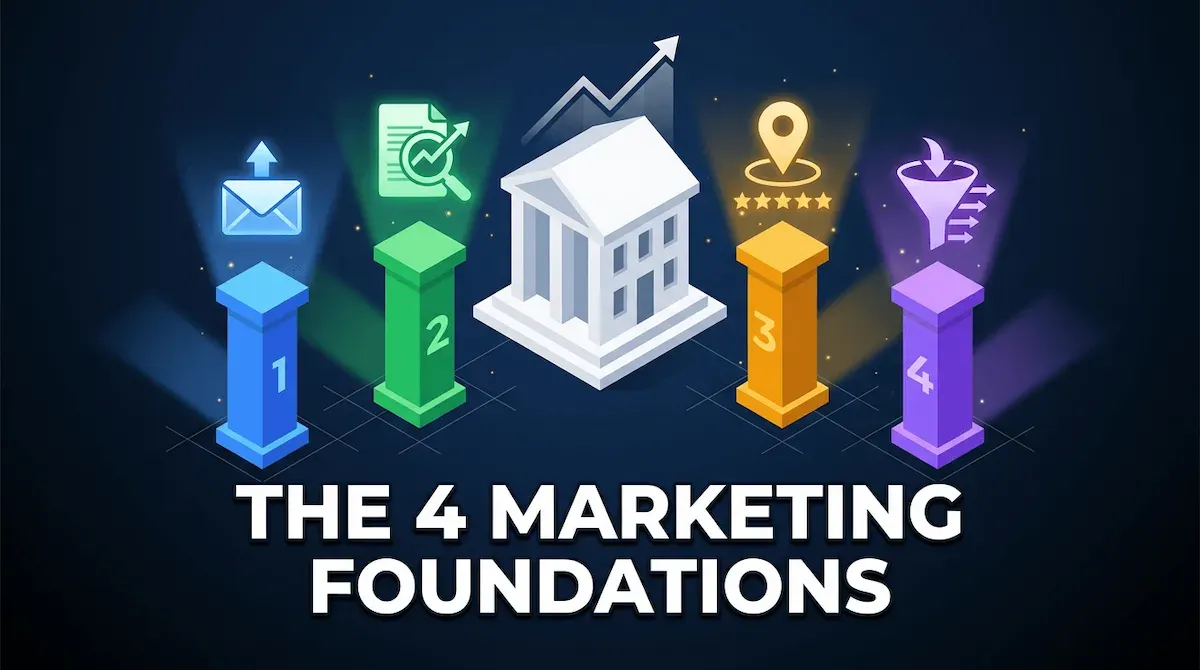
Before we get into growth channels, paid strategies, and automation stacks, I want to make something clear: if the foundation is broken, nothing built on top of it will hold. I have watched entrepreneurs spend thousands on ads while ignoring a Google Business Profile with the wrong phone number. I have seen beautifully produced social content drive traffic to a website with no email capture in sight. Every time, the result is the same — activity without compounding return.
These first four marketing solutions are not glamorous. But they are the ones that quietly generate more revenue per dollar spent than almost anything else in your business.
Solution 1 — Email Marketing
For every $1 spent on email marketing, the average return is $36 OptinMonster — and that number has held steady for years despite the rise of every new platform promising to replace it. Email is not dying. It is the only channel where you own the audience, control the delivery, and do not pay a platform every time you want to reach the people who already said yes to you. The key word is system. A welcome sequence that nurtures new subscribers, a weekly value email that builds trust, and a re-engagement flow that brings cold contacts back — built once, running forever.
💡 Automate it:
Build a 5-email welcome sequence in ConvertKit, Mailchimp, or MailerLite triggered the moment someone joins your list. Follow it with a weekly broadcast on a fixed schedule. Add a re-engagement sequence that fires automatically after 60 days of inactivity. Total setup time: one afternoon. After that, it runs without you indefinitely.
Solution 2 — SEO Content Marketing
Every blog post, guide, or FAQ page you publish is a 24/7 sales rep that works while you sleep. Unlike paid ads that stop the moment you stop paying, SEO content compounds over time. A post that ranks on page one for a buying-intent keyword can generate leads for years from a single afternoon of work. When you pair content creation with automated marketing for small business distribution tools, the compounding effect accelerates even further — and it remains the single most underutilised asset in the small business marketing toolkit.
💡 Automate it:
Use a tool like Surfer SEO or NeuronWriter to brief and optimise your content, then set up a Zapier workflow that automatically shares each new post to your email list and social channels the moment it publishes. Your content goes from written to distributed across every channel without a single manual step.
Solution 3 — Google Business Profile
This one is completely free and almost universally neglected. A Google Business Profile listing with accurate, complete information gets seven times more clicks than an incomplete one SeoProfy — and 88% of consumers who conduct a local search on their smartphone visit or call a business within a day. SeoProfy If your profile has missing hours, no photos, or zero reviews, you are invisible to buyers who are ready to spend money right now. This is the highest-ROI free tool in existence for any business with a local presence.
💡 Automate it:
Use a tool like Semrush Local or BrightLocal to schedule weekly Google Business Profile posts automatically and monitor new reviews in real time. Set up automated email or SMS alerts the moment a new review comes in — so you respond within the hour, every time, without manually checking your profile.
Solution 4 — Lead Magnet System
Your website should never be a brochure. It should be a lead capture engine. A well-designed lead magnet — a checklist, a template, a short guide that solves one specific problem — converts passive visitors into email subscribers you can nurture over time. This is the bridge between your SEO content and your email marketing system. Without it, traffic arrives, looks around, and leaves forever. With it, every visitor becomes a potential long-term customer.
💡 Automate it:
Connect your lead magnet opt-in form (ConvertKit, MailerLite, or even a simple Typeform) to an automated delivery sequence: the moment someone subscribes, they receive the lead magnet instantly, followed by a 3-email nurture sequence over the next week. The entire capture-to-nurture journey runs without you touching it.
These four foundations feed each other: content drives traffic, the lead magnet captures it, email nurtures it, and your Google profile converts local intent directly into calls. Build them in that order and you will have a marketing engine that compounds with or without you — and the automation in marketing systems that connect all four are simpler to build than most people think.
The next four solutions are where most small businesses see their fastest growth — but only once this foundation is solid.
3) Marketing Solutions for Small Businesses 5–8: The Growth Channels That Run Without a Team
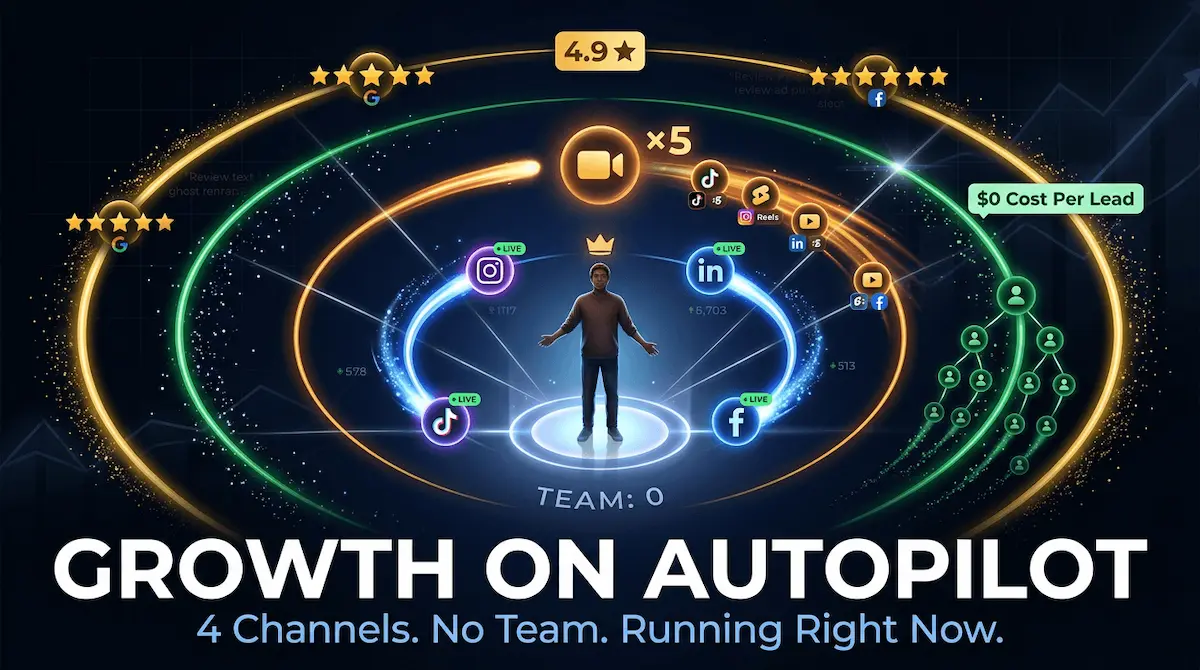
Here is where the strategy starts to get interesting. The four foundations we covered in the previous section are about capturing demand that already exists — people searching for what you offer, people visiting your website, people already in your community. These next four solutions are about creating demand. They are the channels that put your business in front of people who have never heard of you, build trust faster than any ad ever could, and — critically — can be largely automated once the system is built.
If you want to understand how these pieces connect into a single automated engine, the full breakdown is in our guide on automation in marketing. But for now, let us walk through each one.
Solution 5 — Social Media Automation
I want to be clear about something: I am not suggesting you post and pray. I am suggesting you build a content system, batch your content once a week, and let automation handle distribution while you focus on your actual business. Businesses spend an average of 6–10 hours per week per platform managing social media manually — and automation can cut that workload by up to 70% Templated, saving roughly 30 hours a month. That is nearly a full working week returned to you, every single month. The goal is not to be everywhere. It is to show up consistently on the one or two platforms where your buyers actually spend time.
💡 Automate it:
Batch-create one week of content in a single sitting, then schedule everything using Buffer, SocialBee, or Later. Set up auto-publishing across all your platforms simultaneously. Add a simple Zapier trigger that repurposes your best-performing posts into your email newsletter automatically — one piece of content, multiple channels, zero extra work.
Solution 6 — Short-Form Video
This is the highest-organic-reach channel available to small businesses right now — and most entrepreneurs are either ignoring it or overthinking it. Of all video formats, short-form delivers the highest ROI and ranks first for both lead generation and engagement HubSpot, according to HubSpot's research across hundreds of video marketers. A 60-second video answering a question your customers ask constantly costs nothing to produce and can reach thousands of people who have never heard of you. This is not about going viral. It is about showing up as a real human being with expertise — consistently enough that when someone needs what you offer, you are already top of mind.
💡 Automate it:
Record one raw video per week and run it through a tool like Opus Clip or Descript to automatically generate 3–5 platform-ready short clips with captions. Schedule all clips across TikTok, Instagram Reels, and YouTube Shorts using your social scheduler. One recording session produces an entire week of multi-platform video content.
Solution 7 — Referral System
Word-of-mouth has always been the most trusted form of marketing. What most small businesses get wrong is treating it as something that just happens rather than something you deliberately architect. Referrals are five times more likely to convert than leads generated through other marketing methods Firework — and referred customers cost roughly half as much to acquire. The difference between businesses that grow through word-of-mouth and those that do not is almost never the quality of their product. It is whether they have a system that makes referring easy, automatic, and rewarding.
💡 Automate it:
Set up a trigger in your CRM or email platform: 7 days after a purchase or project completion, an automated email goes out asking for a referral with a clear incentive and a one-click sharing link. Tools like ReferralHero or a simple ConvertKit sequence handle the entire flow — request, tracking, and reward delivery — without any manual follow-up.
Solution 8 — Review Management
88% of consumers trust online reviews as much as personal recommendations User's blog — yet most small businesses leave their review profiles completely unmanaged. No response to negative reviews. No system to request new ones. No strategy whatsoever. A structured review management system turns one of your most powerful trust signals into something that works for you around the clock. It also feeds directly back into Solution 3 — a steady flow of fresh, positive reviews is one of the fastest ways to improve your Google Business Profile ranking and win more local search visibility.
💡 Automate it:
Use a tool like NiceJob, Podium, or a simple automated email sequence to request reviews 48 hours after every completed transaction. Set up a Slack or email alert that notifies you instantly when a new review is posted anywhere — Google, Yelp, Facebook — so you can respond within the hour. Fast responses signal to Google that your business is active and engaged.
These four solutions compound when they are connected. A short-form video drives a new follower to your profile, your automation and ai tools nurture them with consistent scheduled content, a strong review presence closes their hesitation, and a referral system activates your happiest customers to do your marketing for you. The automation business process that ties all four together is simpler to build than most people expect — and Section 4 covers the four advanced solutions most small businesses never get around to implementing.
4) The Advanced Strategies Most Small Business Owners Never Implement — Numbers 9–12
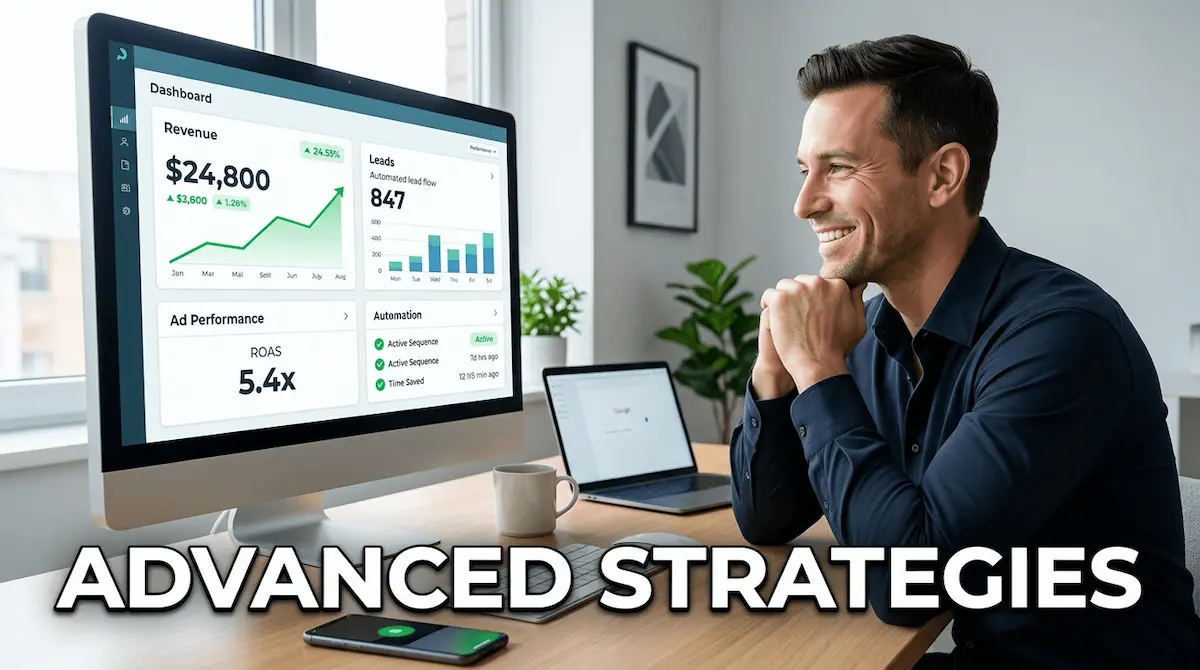
I will be honest with you: most small business owners never get here. Not because these solutions are complicated — they are not. They stop here because the first eight solutions kept them so busy doing marketing that they never found time to think strategically about it. That is the trap. And it is exactly why most businesses plateau.
These final four solutions are where the real separation happens. They are the difference between a business that grows predictably and one that grows randomly — and every single one of them can be automated to run largely without you.
Solution 9 — Marketing Automation Workflows
This is the solution that ties everything together. Not a single tool, not a single campaign — a connected system of automated triggers, sequences, and workflows that moves your prospect from first contact to paying customer without you manually nudging them at every step. The numbers here are difficult to ignore: automated emails generate 320% more revenue than non-automated emails, and despite making up just 2% of email sends, automated messages drove 37% of all email-generated sales in 2024. Revenue Memo That ratio tells you everything. Automation does not replace your marketing. It makes every piece of it work exponentially harder.
The full architecture of what this looks like — how it connects to your automation in marketing strategy, which triggers to set up first, and which tools to use at each budget level — is covered in detail in our pillar guide. But the starting point is always the same: map the journey, identify the gaps where leads fall through, and plug each gap with one automated workflow.
💡 Automate it:
Start with three core workflows: (1) a lead nurture sequence triggered by opt-in, (2) an abandoned inquiry follow-up triggered when someone visits your pricing page but does not convert, and (3) a post-purchase upsell sequence triggered after payment. Build these in ActiveCampaign, HubSpot, or ConvertKit. These three alone cover the majority of your revenue leakage.
Solution 10 — Paid Advertising (Done Right)
Paid ads have a reputation problem. Every entrepreneur has a story about burning budget on Google or Meta with nothing to show for it. And honestly, most of those stories are true — because most small businesses run paid ads without the foundation to support them. No clear offer. No conversion-optimised landing page. No retargeting sequence. Ads dropped cold into a system with nowhere to go. Businesses make an average of $2 for every $1 spent on Google Ads DemandSage — but that average includes everyone who runs ads correctly and everyone who does not. When you run them with a proper funnel behind them, the returns look very different. Paid ads are not a starting point. They are an accelerant you pour onto a foundation that already converts.
💡 Automate it:
Use Google's Performance Max or Meta Advantage+ campaigns — both use AI to automatically allocate budget across placements, audiences, and creatives in real time. Connect your campaigns to your CRM via Zapier so every new lead is automatically tagged, segmented, and dropped into the right nurture sequence without any manual sorting.
Solution 11 — Strategic Partnerships
This is the most underrated growth channel in small business marketing, and it costs almost nothing to execute. A strategic partnership — a formal referral arrangement with a complementary business that already serves your exact customer — puts you in front of a warm, pre-qualified audience that another business has spent years and money building. A bookkeeper who partners with a business coach. A wedding photographer who partners with a florist. A web designer who partners with a copywriter. The math is simple: their trust transfers to you instantly, and your customer acquisition cost drops close to zero.
What makes this scalable is systematising the referral exchange so it does not depend on anyone remembering to mention the other person. This connects directly to the kind of automation and ai workflows that track partner referrals, send automated updates to partners, and ensure every referral is followed up without anything slipping through.
💡 Automate it:
Set up a simple partner portal using a tool like PartnerStack or a custom Notion page with trackable referral links generated through ReferralHero. Every time a partner sends a referral, an automated email sequence fires — thanking the partner, welcoming the prospect, and routing the lead directly into your CRM with the partner tagged for commission tracking.
Solution 12 — AI-Powered Personalisation
Every other solution in this list works better when the content your audience sees is tailored specifically to them. AI-powered campaign management delivers 20–30% higher ROI compared to traditional methods LoopexDigital — not because it spends more, but because it stops wasting spend on people who were never going to convert. Personalisation at scale used to require a full marketing team and enterprise software. In 2026, a solopreneur with the right stack can deliver personalised email content, dynamic website messaging, and segmented ad creative automatically — based on how each individual has interacted with their business. This is not the future. It is available right now, and most of your competitors are not using it yet.
💡 Automate it:
Use ActiveCampaign or Klaviyo's conditional content blocks to automatically show different email content based on subscriber tags, purchase history, or engagement level — all without creating separate campaigns. Pair this with a tool like Mutiny or RightMessage to dynamically change your website headline and CTA based on where each visitor came from. One setup, infinite personalisation.
All 12 solutions are now on the table. But knowing what they are is only half the equation — the half that most blog posts stop at. The part that actually moves revenue is knowing how to connect them into one automated system that runs while you focus on your business. That is exactly what Section 5 covers.
5) How to Automate Every Single One Without a Team or a Tech Background
Here is the question I hear most often when I walk entrepreneurs through these 12 solutions: "This all sounds great — but I am not technical. How do I actually build any of this?"
I understand the hesitation. The word "automation" conjures images of developers writing code, complex dashboards with blinking metrics, and a learning curve steep enough to eat six months of your time before you see a single result. That is not what this looks like in 2026. Not even close.
The reality is that the tools available to small businesses today are drag-and-drop, no-code, and deliberately built for people running a business — not for people who want to become software engineers. Marketing automation saves companies 6 or more hours per week on routine tasks like social media posting and email marketing Firework — and the businesses capturing those hours are not tech companies with dedicated engineering teams. They are solopreneurs and small business owners who made a decision to stop doing manually what a tool could do automatically.
Let me show you exactly how the automation layer maps across all 12 solutions, grouped by the type of tool that powers them.
The Three Layers of Your Automation Stack
Think of your marketing automation in three layers, each one building on the one below it.
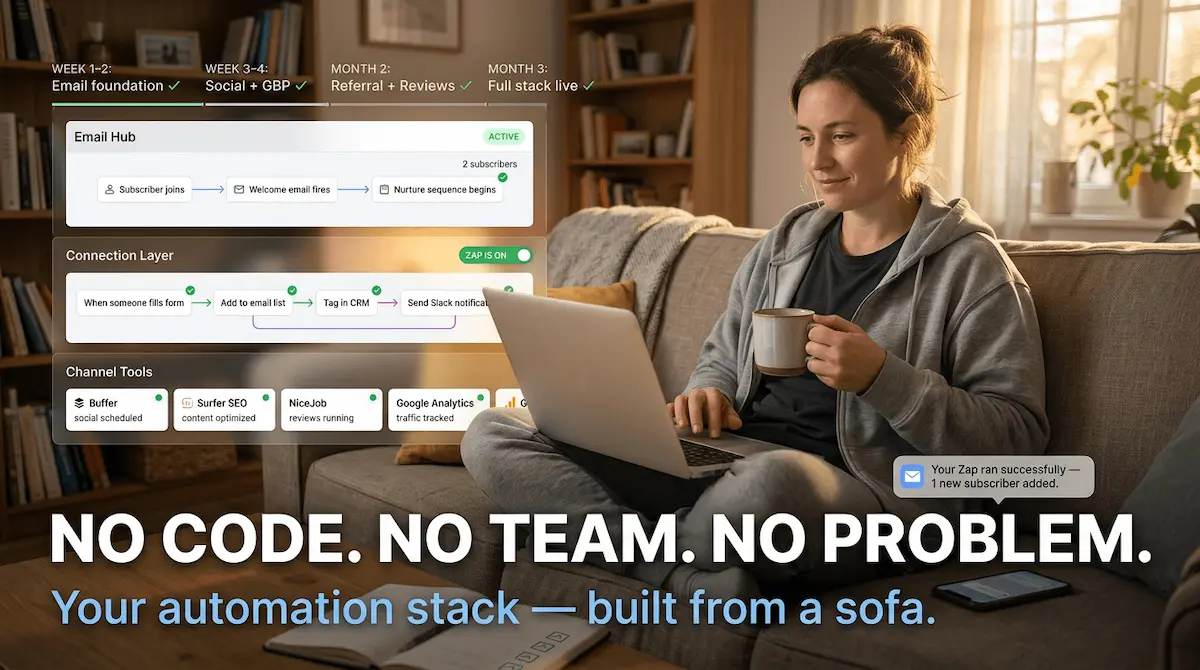
Layer 1 — Your Email and CRM Hub is the engine. Everything flows through here. This is where your leads land, where your sequences fire, and where your customer journey is tracked. For most small businesses, one of these three tools covers everything you need at this layer: ConvertKit (best for content creators and solopreneurs), ActiveCampaign (best for businesses that need deeper segmentation and behavioural triggers), or MailerLite (best if you are just starting out and want something clean and affordable). This single tool handles Solutions 1, 4, 7, 8, 9, and 12 — more than half your entire automation stack.
Layer 2 — Your Connection Layer is what ties your other tools together. Zapier and Make (formerly Integromat) act as bridges between platforms that do not natively talk to each other. When someone fills out a form on your website, Zapier can simultaneously add them to your email list, tag them in your CRM, notify you in Slack, and schedule a follow-up task — all in the same instant, without you doing anything. Both tools have free plans. Both are genuinely no-code. If you can build a spreadsheet, you can build a Zap. This layer connects Solutions 3, 5, 6, 7, 10, and 11 to your central hub.
Layer 3 — Your Channel-Specific Tools handle the individual jobs. A scheduling tool like Buffer or SocialBee for social media (Solution 5). Opus Clip or Descript for video repurposing (Solution 6). Semrush or Surfer SEO for content optimisation (Solution 2). Google Performance Max or Meta Advantage+ for paid ads with built-in AI bidding (Solution 10). Each of these tools has its own automation built in — you are not building from scratch, you are turning on features that already exist.
The Priority Roadmap: Where to Start
The biggest mistake I see entrepreneurs make with automation is trying to build everything at once. They spend a weekend setting up twelve tools, nothing talks to anything, and they abandon the whole thing by Monday. Do not do this.
Instead, follow this three-phase approach. In the first two weeks, build your email foundation: set up your email platform, create your lead magnet delivery sequence, and write your welcome series. That single setup activates Solutions 1 and 4 and starts compounding immediately. In weeks three and four, connect your social scheduling and set up your Google Business Profile monitoring — Solutions 3 and 5 running on autopilot within a month of starting. From month two onwards, layer in your referral trigger, your review request sequence, and your first automation workflow connecting your CRM to your other tools. By month three, you have a functioning, automated marketing system — built without a single line of code, without a tech team, and without burning your weekends.
Automation saves marketers an average of 2.3 hours per campaign Thunderbit — multiply that across every campaign you run in a year and you are reclaiming weeks of your life, not hours. That is the real return on the time you invest in setting this up. And if the idea of setting any of it up yourself still feels daunting — that is exactly why the how to use AI for your business resources in our library exist.
💡 Your automation priority checklist:
Week 1–2: Set up email platform → build welcome sequence → connect lead magnet delivery
Week 3–4: Schedule social content → activate GBP monitoring alerts
Month 2: Build referral trigger email → activate review request sequence
Month 3: Connect CRM to all other tools via Zapier → activate retargeting ads → turn on AI personalisation
Total estimated setup time: 8–12 hours across 3 months. Time saved per month after setup: 20–40 hours.
You now have the full picture of what to automate and how to sequence it. But knowing which tools to use is only part of it — the other part is understanding how to stack them into a lean, cost-effective system that covers all 12 solutions without draining your budget. That is exactly what Section 6 covers.
6) Your Lean Marketing Tech Stack: Cover All 12 Solutions for Under $150/Month

Most entrepreneurs I talk to assume building a complete marketing system means spending a fortune. They picture enterprise software contracts, dedicated tech teams, and invoices that make their eyes water. That assumption is costing them. Not just money — but the time they keep spending doing manually what a $20/month tool could handle on autopilot.
Here is the reality check: 66.3% of small business owners spend less than $1,000 on marketing each year Revenue Memo — and a significant chunk of that gap is not strategy, it is just not having the right tools in place. Meanwhile, monthly digital marketing budgets at SMEs hover near $400 Mordor Intelligence, with most of that going toward paid ads rather than the infrastructure that makes every other channel work harder.
The good news? You do not need a $400/month tool budget to cover all 12 marketing solutions in this post. With the right stack, you can automate your email marketing, social scheduling, SEO monitoring, review requests, referral system, and lead nurture — the whole thing — for well under $150 per month. Here is exactly how.
The Complete Lean Stack — Mapped to All 12 Solutions
This is the stack I would recommend to any solopreneur or small business owner starting from a clean slate in 2026. Every tool has been chosen for three reasons: it handles multiple solutions (so you are not paying for twelve separate subscriptions), it is no-code and beginner-friendly, and it grows with you.
Email platform + CRM + automation hub — MailerLite or ConvertKit ($0–$25/month) This single tool covers Solutions 1, 4, 8, 9, and 12. Your email list lives here. Your welcome sequence, lead magnet delivery, nurture flows, post-purchase upsell emails, and re-engagement campaigns all run from this one dashboard. MailerLite's free plan handles up to 1,000 subscribers and 12,000 emails per month — more than enough to start. ConvertKit's free plan goes to 10,000 subscribers, making it the better choice if you are already growing.
Social media scheduler — Buffer or SocialBee ($6–$19/month) Covers Solution 5. Batch your content once a week, schedule it across every platform, and walk away. Buffer's entry plan starts at $6/month per channel. SocialBee's Starter plan at $19/month includes multiple channels and content category rotation — worth the extra spend if you want evergreen content recycling built in.
SEO + content optimisation — Surfer SEO or Ubersuggest ($12–$29/month) Covers Solution 2. Ubersuggest at $12/month gives you keyword research, site audits, and competitor tracking. Surfer SEO's Essential plan at $29/month adds real-time on-page optimisation as you write — the closer you are to publishing SEO content regularly, the more it pays back.
Connection layer — Zapier or Make ($0–$10/month) Covers Solutions 3, 6, 7, 10, and 11 — bridging all your other tools together. Make's free plan allows 1,000 operations per month, which handles most basic automation needs. Zapier's free tier covers 100 tasks/month, enough to test your first workflows before upgrading.
Review management — NiceJob or Google's native alerts ($0–$29/month) Covers Solution 8. Google's free review link combined with a simple Zapier automation to trigger a follow-up email handles the basics at zero cost. NiceJob at $29/month automates the entire review request sequence with timing, follow-ups, and multi-platform distribution if you want a polished, hands-off system.
Google Analytics + Google Search Console + Google Business Profile — Free Covers Solutions 2, 3, and performance tracking across everything else. These three Google tools together give you keyword ranking data, site traffic analysis, local search performance, and customer action metrics — at no cost whatsoever.
Total monthly investment: $37–$112/month, depending on which tier of each tool you choose. Even at the top end, that is a complete, automated marketing system covering all 12 solutions for less than you would spend taking a client to lunch.
📦 Your lean stack at a glance:
MailerLite or ConvertKit — email, sequences, automations ($0–$25/mo)
Buffer or SocialBee — social scheduling ($6–$19/mo)
Ubersuggest or Surfer SEO — SEO and content ($12–$29/mo)
Make or Zapier — automation bridge ($0–$10/mo)
NiceJob or Google alerts — review management ($0–$29/mo)
Google Analytics + Search Console + GBP — tracking and local SEO (free)
Total: $37–$112/month. Covers all 12 solutions.
The Rule That Saves You From Tool Sprawl
One thing I have seen derail more entrepreneurs than almost anything else: they sign up for too many tools, nothing integrates cleanly, and they end up spending more time managing software than actually marketing their business. The average marketing team uses 11 different tools, requiring constant context switching, manual data transfers, and separate training investments. Averi That is a trap designed for enterprise teams with dedicated ops staff — not for someone running a business solo or with a small team.
The rule is simple: one tool per functional job, chosen for its integration with everything else in your stack. Every tool above connects natively to Zapier and Make. That means your email platform talks to your social scheduler, your review requests fire from your CRM, and your referral links track back to individual contacts — automatically, without you building anything custom or hiring a developer to wire it together.
For entrepreneurs who want even deeper automation capabilities, this is also where the AI tools for entrepreneurs in our content library come in — specifically the resources on building no-code automation systems that layer AI on top of the workflows above to add content generation, lead scoring, and personalisation without additional headcount.
The stack above is not the ceiling. It is the floor — a lean, functional foundation that handles all 12 marketing solutions, runs largely on autopilot, and costs less per month than most people spend on streaming subscriptions. From here, you scale what is working, cut what is not, and add tools only when a specific gap in your results demands it.
Now that you have the full system — twelve solutions, the automation layer, the tech stack, and the budget — the last thing most entrepreneurs want to know is how to measure whether any of it is actually working. That is exactly what the conclusion pulls together.
The Bottom Line: You Now Have the Blueprint. The Only Question Is What You Do With It.
Let me be straight with you for a moment.
You just read 4,000 words covering 12 marketing solutions for small businesses, the automation layer that powers all of them, a no-code tech stack that runs the whole thing for under $150 a month, and a phased implementation roadmap you can start this week. That is more actionable marketing strategy than most business owners get from a $2,000 course.
But here is what I have learned after working with entrepreneurs at every stage: information alone does not move the needle. Knowing what to do and actually having everything you need to do it are two very different things. Most people will read this post, feel genuinely fired up, open a new tab to start researching tools — and then get pulled into their actual business before anything gets built.
I am not saying that to be harsh. I am saying it because I have watched it happen over and over again. The entrepreneurs who actually implement these systems are not smarter or more motivated than the ones who do not. They just have fewer decisions to make at the starting line. The template is already done. The workflow is already mapped. The prompt is already written. They show up, they customise, they deploy. And they are live in a fraction of the time.
That is the entire reason Vault AI Pro exists.
What "Done for You" Actually Means
Every solution in this post has a corresponding resource inside the Vault. Not a vague guide pointing you toward more research — an actual ready-to-deploy asset. The 5-email welcome sequence template you can drop into MailerLite or ConvertKit in an afternoon. The social media content calendar with 30 days of prompts already written. The referral email trigger copy, the review request sequence, the lead magnet delivery workflow, the Google Business Profile post schedule. The Zapier and Make automation blueprints mapped to the exact tools we covered in Section 5.
These are not the kinds of resources you find on a Google search. They are built by practitioners, tested in real businesses, and updated weekly because marketing does not stand still.
More than 1,000 resources. Every one of them ready to use the moment you log in.
The Math That Makes This a No-Brainer
Think about what one of these 12 solutions is worth to your business if it actually runs. A working email welcome sequence that converts new subscribers into paying customers on autopilot. A social media scheduling system that keeps your brand visible on four platforms without you touching your phone every morning. A referral trigger that turns your best customers into your most effective sales team.
At $50/hour — the kind of rate a decent freelancer would charge to build any one of these — a single well-built automation workflow pays for months of Vault AI Pro membership before you have even opened the second resource.
The vault is not an expense. It is the most efficient investment you can make in the one resource you can never get back: your time.
One More Thing Before You Go
If you have made it this far, you already know what the right next move is. You came here looking for marketing solutions for small businesses. You have them — all twelve, with the automation playbook and the tech stack to match. The only remaining question is whether you want to spend the next three months figuring out how to build all of it from scratch, or whether you want to walk into a vault that has already done that work for you.
Every template. Every workflow. Every prompt. Every checklist. All in one place, updated weekly, built for entrepreneurs who are running a real business and cannot afford to waste time reinventing wheels that already exist.
🔓 YOUR MARKETING SYSTEM IS ALREADY BUILT
1,000+ ready-to-deploy AI prompts, automation workflows, email sequences, templates, and playbooks. Every solution in this post — done for you and waiting inside the Vault.
Unlock the Vault — Get Instant Access ➜Join 10,000+ entrepreneurs saving 3–5 hours a day — that's 100+ hours back every single month.